Companion planting works—but only when you know why a pairing works. The most reliable horticultural guidance, including Washington State University's extension publication by Linda Chalker-Scott, frames companion planting as a legitimate practice built on ecological principles, and it explicitly warns that pseudoscientific claims abound in popular literature. This guide organizes the practice the way the evidence does: by mechanism. Once you can name the benefit a plant provides—confusing pests, feeding the soil, offering shade or support—you can design your kitchen garden to solve specific problems rather than copying folklore charts.
Beyond Folklore: The Science of Companion Planting
Companion planting is the practice of growing different crops near one another to enhance production, repel damaging pests, improve soil health, and promote biodiversity, as Denver Urban Gardens summarizes it. WSU's Chalker-Scott goes further, arguing that scientifically sound companion planting improves plant health and productivity, decreases insect and disease damage, and reduces the need for pesticides and fertilizers.
The key is separating two kinds of interactions. WSU's framework divides the science into chemical alterations—such as nitrogen fixation and volatile organic compounds—and biological alterations, including enhanced biodiversity, support for beneficial insects, and behavioral disruption of harmful ones. The University of Minnesota extension adds a caution worth keeping in mind all season: long online lists of plants that "repel insects" are not always accurate or research-backed. Focus on pairings with a known mechanism, not a long chart of unverified claims.
Mechanism 1: Pest Deterrence and Disruption
Some insects find their host plants visually. The University of Minnesota extension explains that pests use cues like leaf shape and color, so a solid block of one crop is easier to locate than a mixed planting with varied heights, colors, and textures. Interplanting diverse species makes your target crops literally harder to see.
Chemical deterrence works alongside this visual confusion. WSU lists volatile organic compounds among the science-based mechanisms, and a University of Florida Cooperative Extension herb chart attributes specific repellent effects to specific herbs: rosemary near cabbage, beans, and carrots is credited with deterring the cabbage moth, bean bug, and carrot fly; sage with the cucumber beetle, flea beetle, and slugs; and southernwood with the cabbage moth. Basil is listed as repelling Japanese beetles. These are traditional extension recommendations, so treat them as tested pairings to try, not guarantees.
Mechanism 2: Attracting Beneficial Insects
Not every companion repels something; some invite allies. WSU's biological alterations include enhancing biodiversity and attracting beneficial insects and birds that prey on pests or pollinate crops. Denver Urban Gardens makes the same point: flowering plants draw in the insects that do free pest control and pollination for you.
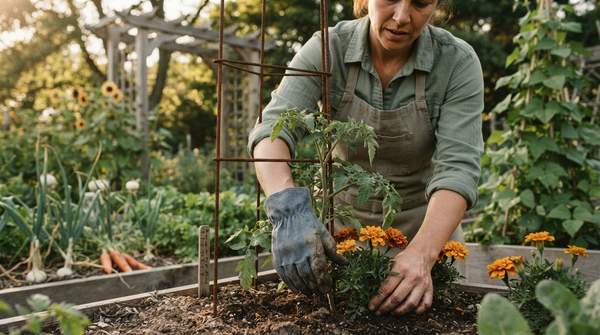
In practice, this means weaving flowering herbs and annuals through your vegetable beds rather than banishing them to a border. Herbs like thyme, yarrow, and tansy flower and feed the ecosystem around your crops. The Florida extension chart even suggests yarrow planted near aromatic herbs to enhance their essential oils. The principle is simple: a garden that feeds beneficial insects all season is a garden where pest populations face natural predators.
Mechanism 3: Soil Health and Nutrient Enhancement
Some companions give back to the ground itself. The clearest example is nitrogen fixation: legumes partner with soil bacteria to convert atmospheric nitrogen into forms plants can use. WSU lists nitrogen fixation first among its chemical alterations, and the classic demonstration is the Three Sisters garden.
In the ancestral Three Sisters or Milpa system—corn, beans, and squash grown together—the beans supply nitrogen to the soil that feeds the corn and squash, according to Denver Urban Gardens. If your soil is lean or your crops are heavy feeders, a legume companion is the mechanism to reach for. This is also where honest accounting matters: WSU's evidence supports improved plant health and reduced inputs, and the Three Sisters pairing is the celebrated example, but no source establishes that every companion combination boosts yields.
Mechanism 4: Physical Support and Microclimate Creation
The third leg of the Three Sisters shows structure at work. Corn provides a living trellis and shelter for climbing beans and peas, while the broad leaves of squash and pumpkin shade smaller plants that need sun protection and suppress weeds by covering the soil, as Denver Urban Gardens describes.
This mechanism is pure physics, no chemistry required. Use tall crops as trellises for climbers, use sprawling foliage as living mulch to shade the soil and smother weeds, and position sun-sensitive crops in the shelter of taller neighbors. Structure and microclimate are the most reliable benefits in companion planting because they depend on plant architecture, not on contested claims about invisible chemical signals.
Companion Planting Strategies by Scientific Mechanism
Use this framework to match a garden problem to the mechanism that solves it, then choose a pairing known to deliver that benefit.
| Mechanism | How it works | Example pairings |
|---|---|---|
| Pest deterrence (visual) | Varied heights, colors, and textures make target crops harder for insects to locate | Mixed interplanting of diverse vegetables instead of solid blocks of one crop |
| Pest deterrence (chemical) | Aromatic compounds repel or disrupt specific pests | Rosemary with cabbage, beans, carrots (cabbage moth, bean bug, carrot fly); sage with cabbage (flea beetles, slugs) |
| Attracting beneficial insects | Flowers enhance biodiversity and draw pollinators and pest predators | Flowering herbs such as thyme, yarrow, and tansy woven through beds |
| Soil health and fertility | Legumes fix nitrogen that feeds neighboring crops | Beans supplying nitrogen to corn and squash in the Three Sisters |
| Physical support and microclimate | Tall plants trellis climbers; broad leaves shade soil, protect smaller plants, and suppress weeds | Corn supporting climbing beans; squash leaves shading low crops |
| Incompatible: allelopathy | One plant releases growth-inhibiting substances | Fennel inhibiting beans and tomatoes—give fennel its own bed |
| Incompatible: shared pests and disease | Neighbors attract the same pests and share disease vulnerability | Potatoes and tomatoes, both prone to blight |
Read the table as a diagnostic tool. Nitrogen-hungry soil? Reach for a legume mechanism. A specific pest? Match it to a listed repellent herb. A climbing crop with no trellis? Plant it beside corn. Every row answers a different problem with a different mechanism.
Avoiding Detrimental Pairings: Plants to Keep Apart
Companion planting cuts both ways, and the negative pairings are better documented than many positive ones. Fennel is the classic offender: gardening guidance notes it inhibits the growth of many plants, including beans and tomatoes, and should be planted in a separate section of the garden. One amateur gardener in England reported stunted growth and smaller harvests after planting fennel too close to beans—an anecdote, but consistent with the general warning.
Shared vulnerability is the second failure mode. Potatoes and tomatoes should not be planted near each other because they attract similar pests and are both prone to diseases like blight. The lesson generalizes: before placing two crops together, ask whether they compete for the same resources or host the same enemies. If either answer is yes, separate them.
Planning Your Evidence-Based Kitchen Garden
Start with your problem, not with a chart. Sketch your beds and label each crop with what it needs—nitrogen, a trellis, shade, protection from a named pest—then assign companions by mechanism from the framework above. Keep fennel isolated, keep potatoes and tomatoes apart, and interplant generously so no single crop forms an easy visual target.
Stay skeptical as you go. The University of Minnesota extension's warning applies to every pairing you encounter online: if a combination comes without a mechanism, treat it as folklore until you find research behind it. Test one or two pairings per season and observe the results in your own soil.
Cultivating a Thriving Garden with Intentional Pairings
Gardeners should plan their kitchen garden layout by selecting companion plants based on their known scientific mechanisms to achieve specific benefits like pest deterrence, soil enrichment, or physical support, while actively avoiding incompatible combinations. The measurable indicator is reduced pest damage, improved plant vigor, and increased yields in areas where evidence-based companion planting principles are applied—with the yield benefit best documented in systems like the Three Sisters rather than guaranteed for every pairing. Watch those treated beds this season: fewer pest bites, sturdier plants, and a heavier bean-and-corn harvest are the evidence your plan is working.
Sources
- Gardening with Companion Plants (Home Garden Series) — PUBS
- Companion Planting Guide - Denver Urban Gardens — Denver Urban Gardens - Cultivating Food, Community, and Climate Resilience on a Human Scale
- Companion planting in home gardens — Extension
- Growables