Creating a formal garden with the timeless elegance of a knot garden or a parterre involves a thoughtful approach to symmetry, geometry, and plant selection. While both styles create structured, aesthetically rich spaces, they are distinguished by their historical origins and the complexity of their patterns. A knot garden evokes an interwoven, ribbon-like design, whereas a parterre often presents a more elaborate, embroidery-inspired layout. Understanding these core differences is the first step in planning a formal garden that brings a sense of order and history to your landscape.
Knot Garden vs. Parterre: A Design Comparison
The choice between a knot garden and a parterre depends on the desired aesthetic, the scale of your space, and your historical inspiration. Knot gardens were established in 16th-century England during the Tudor and Stuart periods, characterized by intricate designs where different colored plants appear to weave over and under one another, much like a Celtic knot. Parterres originated a century earlier in the French Renaissance gardens of the 15th century. They evolved into more elaborate, stylized forms in the 17th-century Baroque era, reaching their peak at the Palace of Versailles.
While similar, their execution differs in key ways. A parterre is often more intricate, featuring decorative arrangements of beds and paths laid out in geometric patterns. In 1638, the horticulturist Jacques Boyceau described parterres as the "low embellishments of gardens," which could be fashioned into compartments, foliage, embroideries, and even coats-of-arms. The following table outlines the primary distinctions to help guide your design choice.
| Feature | Knot Garden | Parterre |
|---|---|---|
| Origin | Established in 16th-century Tudor England. | Originated in 15th-century French Renaissance gardens. |
| Pattern | Intricate, interlacing designs where plants appear to weave under and over each other. | More intricate geometric or embroidery-inspired patterns with decorative arrangements of beds and paths. |
| Hedge Style | Typically edged with box hedging, which can undulate to mimic the look of rope. | Uses tightly clipped, level evergreen plants, often boxwood, to create crisp patterns. |
| Scale | Often designed in square compartments, but adaptable to smaller gardens and different proportions. | Associated with a grander scale but can be designed for spaces ranging from small courtyards to large plots. |
| Infill Materials | Compartments are often filled with herbs or colored gravels. | Beds can be filled with evergreen hedging, bedding plants, turf grass, or gravel. |
Core Design Principles for Formal Gardens
Whether you choose a knot garden or a parterre, the design process is rooted in a set of foundational principles. Both styles are intended to be viewed from a higher vantage point, a concept born from their placement around European castles and estates where they could be appreciated from upper windows. This consideration of viewpoint is crucial for the design's impact.
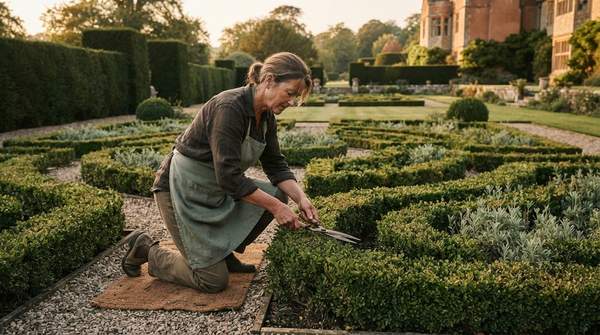
Symmetry is paramount. A formal garden layout begins with establishing a central axis and ensuring the design is balanced on either side. The entire pattern should be meticulously planned on paper before any work begins on the ground. The structure is created with a defined curb or border, which can be made from materials like flagstone, brick, cobblestone, or simple metal edging. This border provides the framework for the entire geometric pattern, which is then reinforced with tightly clipped plants.
Selecting Plants for Structure and Infill
The crisp, intricate lines of knot gardens and parterres depend on a "small, tight, evergreen plant layer." The most common and traditional choice for this structural element is boxwood, which is used to edge the compartments and create the patterns. Its dense growth and tolerance for tight clipping make it ideal for maintaining the sharp, geometric shapes essential to the design.
However, designers have also started using alternatives like yaupon to create these formal hedges. The choice of plant for the structure is critical, as it forms the living architecture of the garden. Within the hedged compartments, the infill material adds color and texture. In knot gardens, this might be a selection of herbs or colored gravels. Parterres can be filled with a wider variety of materials, including turf grass, bedding plants for seasonal color, or gravel paths that wind through the ornamental beds.
Adapting Formal Styles to Modern Gardens
While these garden styles have a history rooted in grand estates, their principles are highly adaptable to contemporary settings of all sizes. According to one garden design publication, parterre gardens can be designed for spaces ranging from small courtyards to large country plots. Their structured patterns can bring a sense of elegance and order to even a compact backyard.
Similarly, knot gardens are not limited to the enormous formal designs seen at historic houses. They work well in small gardens and can be modified to fit the specific proportions of a space. For instance, a long, thin garden might use rectangular compartments instead of the traditional squares to create a harmonious design. The key is to maintain the core elements of a formal, symmetrical pattern and clipped hedging, regardless of the overall scale.
Designing Your Formal Garden: Next Steps
With a clear understanding of the styles and principles, you can begin translating your vision into a physical plan. The success of a knot garden or parterre lies in its precise and balanced execution, which starts with a strong foundational layout. The first practical step is to measure your space and identify the primary line of sight from which the garden will be viewed, such as a patio door or an upper-story window.
Begin by establishing a central axis and defining the overall extents of your chosen formal garden style, ensuring symmetry and considering the primary viewpoint. This initial step creates the canvas for your design. The tangible result of this planning phase should be a clearly marked central axis and equally divided spaces on your garden plot, ready for detailed pattern layout. This framework ensures that the intricate details you add later will contribute to a cohesive and elegant whole.
Sources
- Parterres and Celtic Knot Gardens — Marysbloomers
- What Is a Knot Garden? Design Ideas, Plans and Hedge Plants — Garden Ninja: Lee Burkhill Garden Design
- All About Parterre Gardens with Fransen Mills' John Mills - Southern Home Magazine
- How designers are using Topiary, Knots and Parterres. — Jardin
- How to design a parterre garden – key points to consider — Homes and Gardens