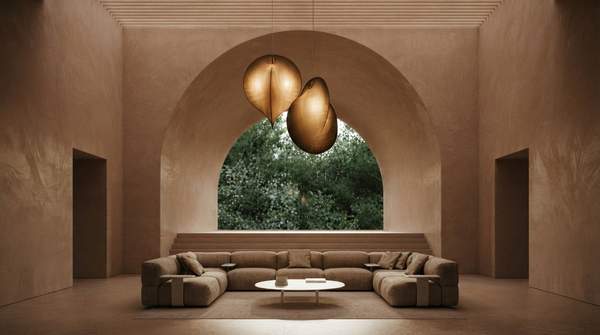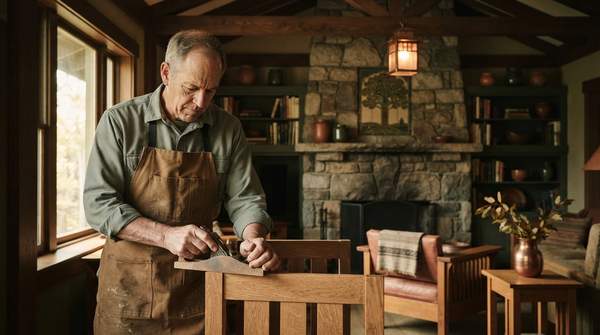
Step into an Arts and Crafts room and you notice what isn't there first: no fussy trim, no machine-made gloss, no ornament pasted over structure. The movement that produced these interiors in the late 19th century began as a rebellion against industrial production, and its philosophy survives in four observable principles—simplicity of form, honesty of materials, visible craftsmanship, and integration with nature. Together they form a diagnostic framework you can apply to any room or piece of furniture.
The Roots of American Arts and Crafts: A Reaction to Industrialization
The Arts and Crafts movement emerged in the late 19th century as a cultural response to the Industrial Revolution's impact on society, which brought increased production but also a decline in craftsmanship quality and detachment in the workforce, as design commentators tracing the movement's history describe. Its original aim was to reinstate the value of craftsmanship and the integrity of design in Britain, challenging mass-produced, low-quality goods. Writing on the movement's British design reform background points to earlier critics, including an 1836 parliamentary committee that worried British-manufactured goods were inferior to those of France, Germany, and the United States—evidence that anxiety about industrial quality predated the movement itself.
In the United States, this inherited philosophy bent toward practicality. Design historians note a desire for simpler living spaces, and the movement's American adherents emphasized fitness of purpose and order over the parlor-bound formality of the Victorian era. Even Edith Wharton and Ogden Codman Jr., writing in 1897, observed that the parlor was passé because "none but rich people can afford to have a room in their houses set apart for the pleasures of idleness." That shift toward lived-in, functional rooms set the stage for the principles that followed.
Principle 1: Simplicity of Form and Function
The first principle holds that beauty should arise from an object's utility rather than its decoration. Members of the movement believed excess ornamentation was unnecessary—an indicator of poor-quality design—and that objects should be designed with their function in mind, with function then determining their characteristics. This is the era's version of "form follows function," and it produced interiors of clean lines and functional furniture without superfluous trim.
The principle had limits worth noting: not every designer insisted on entirely handmade work. The metalworker William Arthur Smith Benson made his teapot with a machine, yet the piece still reads as Arts and Crafts through its simple lines and clean design. When you assess a room, look for that quality of restraint—furniture shaped by use rather than display.
Principle 2: Honesty of Materials and Natural Beauty
Where Victorian factory goods hid their construction behind veneers and applied finishes, Arts and Crafts interiors celebrated raw, natural material. Writing on the movement's design values describes this as showcasing the inherent beauty of natural resources as a direct counter to the artificiality and hidden construction of mass-produced goods. Regionalism—the idea, articulated by the reformer A.W.N. Pugin, that an aesthetic should grow from a region and its indigenous materials—also shaped the palette.
In practice, this meant wood, stone, and textiles chosen for their grain and texture rather than disguised, a point design commentary on the movement's material choices makes directly. Midwestern American interiors followed suit with local hardwoods left honest and unpainted. The test for a piece: can you see what it is made of, and does the material carry the beauty rather than the surface treatment?
Principle 3: Visible Craftsmanship and the Dignity of Labor
The third principle restored the artisan to the object. Critics of industrial production, following John Ruskin, argued that handmade work reflected the individuality of each craftsman, "unlike the dull, repetitive quality of factory-produced objects after the industrial revolution," as Megan Aldrich's study of the Gothic Revival is cited as noting. In interiors, this translated into handcrafted details and exposed joinery—mortise and tenon joints presented as design features rather than concealed. The construction becomes part of the aesthetic.
This is why an Arts and Crafts chair rewards close inspection: the way two members meet is itself the ornament. The broader movement commentary emphasizes handcrafted details and artisanal quality as central to creating distinctive, meaningful spaces—a value later designers have continued to draw on.
Principle 4: Integration with Nature and Harmonious Living
The final principle moves beyond the object to the room's relationship with its setting. Arts and Crafts interiors connected to the natural world through earthy palettes, natural motifs, and open layouts, with large windows blurring the line between indoors and outdoors—a connection that writers on the movement link to a sense of well-being. The philosophy ran deeper than decoration: some contemporary reflections on the movement describe a "lack of connection" in industrial life and a wish to recover lost knowledge and arts from the past, framing craftsmanship itself as restorative.
The Gamble House in Pasadena stands as one of the most complete and best-preserved examples of this holistic American approach, where furniture, fixtures, and architecture were designed together in celebration of craftsmanship.
Core Principles of American Arts and Crafts Interior Design
Use this framework to diagnose any room or piece. Each principle pairs the philosophical basis—why the movement held the value—with its observable manifestation, so identification and understanding arrive together.
| Principle | Philosophical Basis | Design Manifestation to Look For |
|---|---|---|
| Simplicity of Form | Excess ornament signals poor design; function determines an object's characteristics | Clean lines, functional furniture, no superfluous decoration |
| Honesty of Materials | Inherent beauty of raw natural materials, countering artificial mass production | Wood, stone, and textiles with grain and texture left visible |
| Visible Craftsmanship | The artisan's individuality dignifies the work over anonymous factory output | Handcrafted details; exposed joinery such as mortise and tenon joints |
| Integration with Nature | Craft and home life restore a lost connection to work and the natural world | Earthy palettes, natural motifs, open layouts, large windows to the outdoors |
A room that satisfies all four rows—uncomplicated shapes, honest materials, evident handwork, and a visual dialogue with the landscape—reads as thoroughly Arts and Crafts. Most real rooms satisfy some rows more than others, which tells you whether you're looking at a faithful example or a hybrid influenced by later styles.
Applying Arts and Crafts Principles to Your Home
To thoughtfully incorporate elements of American Arts and Crafts design, focus on simplicity, natural materials, visible craftsmanship, and a connection to nature. That means choosing pieces whose shape reflects their use, letting wood or stone show its grain, favoring construction that can be seen, and framing views of the outdoors. The measure of success is a living space that feels harmonious, functional, and celebrates the inherent beauty of its materials and construction. Walk your room against the four rows of the framework and ask, row by row, what is present and what a single considered change—revealing a joint, swapping a veneered piece for solid timber—would add.
Sources
- Arts and Crafts Principles in Interior Design: The Original Minimalists — DailyArt Magazine
- Stu's Woodworks - Understanding the Arts and Crafts “Style” — Stuswoodworks
- The Arts and Crafts Movement: A Harmonious Blend of Form and Function — GALATEA
- Arts and Crafts in Interior and Exterior Design — Utoledo