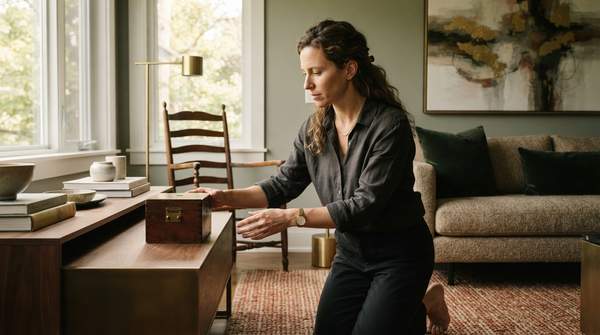
The surest way to make an antique look like a mistake in a modern room is to place it there without deciding what it is doing. Successfully blending an antique chest, chair, or sideboard into a contemporary interior is not accidental—it rests on evaluating the piece's form, material, and scale, choosing deliberately between contrast and harmony, and assigning the piece a role before you ever move it against the wall. Designers across several studios converge on the same core principles: proportion, visual balance, and intention. What follows is a repeatable framework, plus three cohesion techniques, for turning a single old piece into the thing that makes a modern room feel collected rather than mismatched.
The Art of Blending: Why Mix Antique and Modern?
Modern rooms risk feeling interchangeable—clean, competent, and slightly soulless. An antique carries patina, joinery, and a story that no flat-pack piece can imitate, and that history becomes more legible, not less, when it sits against a contemporary backdrop. As Kelsey O'Brien writes for MK Envision Galleries, combining sleek contemporary lines with the charm of antique pieces "creates a unique and personalized space."
The reverse is equally true: an all-vintage room can slide into thrift-store incoherence. Designer Emily Henderson describes her own early interiors this way, concluding that "adding a few contemporary/modern pieces would elevate everything and give a needed context to the vintage." Old gives the new depth; new gives the old context. The mix also solves practical problems, Henderson notes, because pairing eras often delivers more function than either style alone.
Antique-Modern Integration Decision Framework
The matrix below condenses the framework into a sequence you can apply to any single piece. Read it top to bottom: first understand what the antique is, then decide how it should relate to the room, what job it holds, and how you will finish the composition.
| Step | Question to Ask | How to Decide |
|---|---|---|
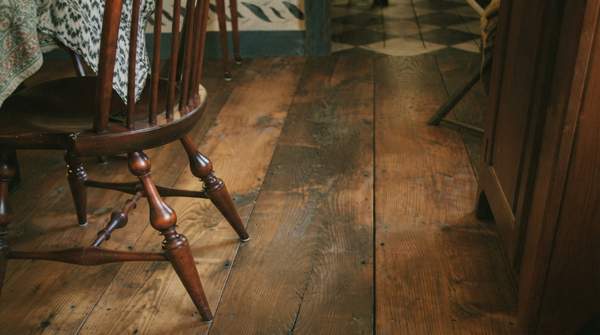
| 1. Evaluate the piece | What are its form, material, and scale? | A carved or hand-carved form reads sculptural; warm textured wood behaves differently than polished metal; generous antique proportions need a room that can hold them. |
| 2. Choose a strategy | Contrast or harmony? | Lean into differences—pair a rustic 18th-century chest with a sleek, cold polished-metal coffee table, or a hand-carved Arts and Crafts chair against floor-to-ceiling glass. For harmony, repeat materials and tones across old and new. |
| 3. Assign a role | Focal point or accent? | Apply the rule of one: a single statement piece per room introduces history without overwhelming it. Smaller antiques—trays, candlesticks, carved boxes—work as accents that add texture and story. |
| 4. Balance the room | Does anything overpower? | A massive 1800s blanket chest overwhelms a small apartment; a delicate Victorian side table disappears in a 12-foot-ceiling loft. Pair heavy antiques with lightweight glass or acrylic to create visual lightness. |
This evaluation is the foundational step for successful integration. Both contrast and harmony are valid strategies, and the role you assign should be determined by the piece's character and the room's overall design—no single answer fits every object.