If you are restoring a period home, the single most consequential flooring decision is species: quarter-sawn oak belongs to the Victorian and Craftsman eras, while pale, fine-grained maple belongs to the Art Deco 1920s. Getting this right is what separates a historically authentic interior from a handsome but anachronistic one. This guide traces how American wood flooring evolved from rough-sawn practicality to era-defining style, so you can match your floor to your home's architectural moment.
The Enduring Appeal of Historic American Wood Floors
A floor is the largest uninterrupted surface in a room, and in historic homes it carries more design information than almost any other element. The story of American wood flooring is, at its heart, a story of function yielding to design: as the flooring specialists at Real Wood Floors observe, early twentieth-century wood flooring was "functional and structural, and certainly not a design feature," and only later did design look back and borrow from the traditional wood floor's own character.
That trajectory matters for restoration. Each era left a distinct fingerprint—species, cut, pattern, and finish all shifted with prevailing tastes. Understanding those fingerprints lets you read an original floor correctly and choose a replacement that speaks the same language. What follows is a chronological framework built from historical accounts of American home design, covering the dominant trends from the early 1800s through the 1930s.
American Wood Flooring Through the Eras: A Historical Timeline
Use this chronology as a quick reference: find your home's period in the left column, and the historically appropriate species and characteristics follow from it. The associations reflect dominant American trends, not universal rules—regional variation and individual choice always existed.
| Era / Dates | Dominant Wood Species | Key Characteristics & Styles |
|---|---|---|
| Early 1800s | Local vernacular woods; tight-grained heartwood | Rough-sawn planks with squared edges, left unfinished—plain, practical, no varnish or stain. Wealthy households added parquet in herringbone, checkerboard, and diamond patterns mimicking oriental rugs. |
| Victorian Era (1850–1930) | Oak, especially quarter-sawn oak | Ray flecks as a hallmark; intricate parquet patterns and herringbone designs conveying opulence and grandeur. |
| Craftsman / Arts & Crafts (1910–1930) | Oak, notably white oak | Continued oak dominance, aligned with the movement's emphasis on natural materials; simpler, more robust installations. |
| Art Deco / Moderne (1920s–1930s) | Maple | Light color and fine grain; clean, sleek appearance reflecting modern aesthetics and the era's hygiene-driven "sanitary craze." |
The pattern to notice is the pendulum: from unadorned utility, to Victorian ornament, to the honest simplicity of oak in the Craftsman years, and finally to the hygienic lightness of maple. Each swing was driven by cultural forces, not mere fashion cycles.
Early American Flooring: Practicality and Emerging Styles (1800s)
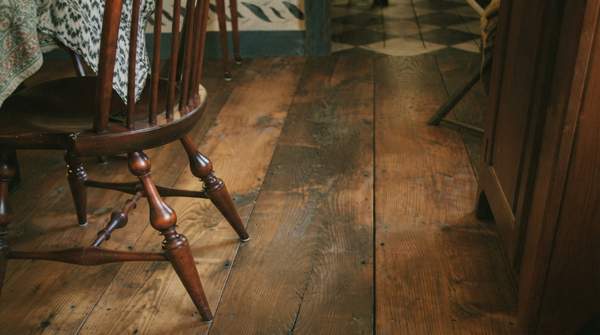
The early nineteenth century was an age of necessity. As Twenty & Oak's history of flooring trends describes, American builders worked largely with vernacular materials—above all the abundant old-growth timber—and floors were typically tight-grained heartwood, rough-sawn with squared edges, and left entirely unfinished. No varnish, no stain: the wood was simply the wood, chosen for availability and service rather than appearance.
Ornament arrived with wealth. In the early 1800s, affluent Americans could afford parquet floors laid in mesmerizing geometric patterns—herringbone, checkerboard, and diamond—designed, according to Twenty & Oak, to mimic the intricate weavings of fancy oriental rugs. These decorative floors were a luxury, not a standard. Later, parquet borders and central medallions let less wealthy households achieve a version of the same look at lower cost, democratizing a style that had begun as a status symbol.
Victorian and Craftsman Eras: The Reign of Oak (1850s–1930s)
Oak transformed the American interior. Scott Sidler, writing at The Craftsman Blog, describes oak as the premier Victorian flooring species, symbolizing opulence and sophistication. The signature was the cut: quarter-sawn oak, with its distinctive ray flecks, became a hallmark of Victorian and American Craftsman homes, lending rooms a sense of grandeur. This was the era of intricate parquet patterns and herringbone designs, showcasing oak's versatility as both a structural and decorative material.
Oak's popularity rested on three legs: durability, availability, and the era's aesthetic appetite for richly figured wood. Its reign extended naturally into the Arts & Crafts movement of 1910–1930, whose philosophy of honest natural materials made oak an obvious partner—furniture maker Gustav Stickley used white oak abundantly in his designs. For a Craftsman home, the historically sympathetic choice is oak in simpler, more robust installations rather than elaborate parquet.
Art Deco and Moderne: The Rise of Maple (1920s–1930s)
The 1920s reversed the palette. With the advent of Art Deco and the era's "sanitary craze," people were drawn to maple for its light color and durability, as Sidler recounts. The clean, sleek appearance of maple flooring reflected the modern aesthetic of the decade, and it was often used in conjunction with Art Deco and Moderne interiors, bringing simplicity and elegance to the home.
The cultural driver here is worth pausing on: hygiene. The sanitary craze was not purely an aesthetic preference—cleanliness itself became a design criterion, favoring pale, easily maintained surfaces. A dark, heavily figured oak floor that read as luxurious in 1890 would have looked heavy and old-fashioned in a 1925 Moderne interior. Light maple was the visual language of modernity.
Choosing Authenticity: Your Next Step in Period Flooring
Select wood flooring that aligns with the dominant species and aesthetic characteristics of your home's architectural period to ensure historical authenticity. The measurable test: the homeowner successfully identifies and sources wood flooring—quarter-sawn oak with visible ray flecks for a Victorian or Craftsman home, light-colored maple for an Art Deco interior—that visually matches the historical descriptions provided. Hold any sample against these era profiles before committing: ray flecks and herringbone say 1850–1930; pale, fine-grained simplicity says 1920s. Where your home's original floor survives, read it first—it is the most reliable evidence of what your builder intended.