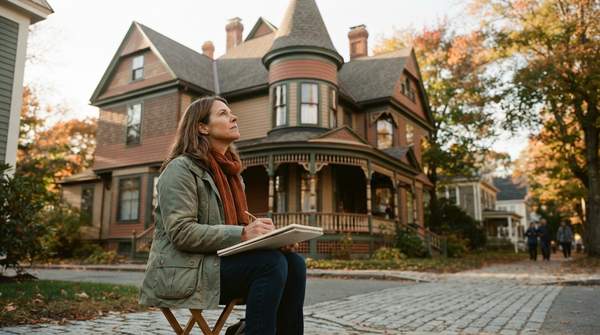
For many people, the Queen Anne style is the architecture of the Victorian age itself: asymmetrical, steeply roofed, and lavishly decorated with towers, porches, and patterned shingles. Yet its very exuberance makes it hard to classify. The practical solution, drawn from municipal design guidance and architectural field guides, is to identify a Queen Anne house in two steps: first determine its primary massing form, then confirm the identification with a checklist of characteristic features.
The Eclectic Charm of American Queen Anne Architecture
The American Queen Anne style flourished roughly from 1880 to 1910, and according to the Pennsylvania Historical and Museum Commission it was the most popular style for houses in the period from 1880 to 1900, appearing in communities across the country in numerous variations of form and detail. High-style examples are often considered local landmarks—ornate, showy attention-getters—and the style was also employed for large-scale public buildings. What unites these varied buildings is a combination of asymmetrical massing, steeply pitched irregular roofs, and an abundance of decorative detail, from corner towers to richly patterned wall surfaces. The commission's field guide notes that despite this variety, the style is easy to recognize once its vocabulary is understood.
A Brief History: From English Roots to American Popularity
The name is a historical misnomer. The style was first created and promoted by the English architect Richard Norman Shaw and his contemporaries in the late nineteenth century, and while the name refers to Renaissance architecture popular during the reign of England's Queen Anne (1702–1714), the Pennsylvania commission points out that the style is actually more closely related to the medieval forms of the preceding Elizabethan and Jacobean eras. Shaw's residential designs, introduced in England in the 1870s, were intended to evoke domestic architecture of some two hundred years earlier, and the British public embraced them.
Americans encountered the style at the 1876 Philadelphia Centennial Exhibit, where two model houses were built in the Queen Anne style, according to Santa Barbara's historic resources design guidelines. From there it spread across the nation at a rapid pace. Its popularity in the United States was fueled by pattern books and the first architectural magazine, The American Architect and Building News, and the imported designs evolved into a distinctly American style with numerous, sometimes regional, variations.