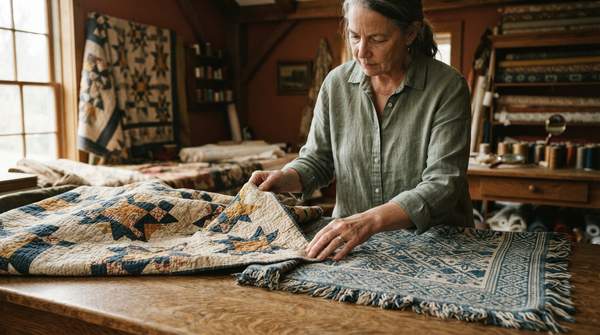
Every historic American bedcovering answers three questions in its very structure: was its design built by sewing small fabric pieces edge-to-edge, by layering cut shapes onto a background cloth, or by weaving the pattern into the fabric itself? Those three answers distinguish the great majority of classic American textiles—pieced quilts, appliqué quilts, and woven coverlets—and they can be read by eye, without specialist training. Once you know what to look for, the seams, the layered edges, and the interlaced threads tell the story themselves.
Introduction to Classic American Textiles
American quilts and coverlets are not isolated craft objects; they sit at the end of a long chain of cultivation, trade, and technology. The American Folk Art Museum's exhibition An Ecology of Quilts frames these textiles as an "intricately woven web of environmental resources, craft and scientific knowledge, global movement, and creative collaboration," encompassing the raw materials harvested from nature, the overland and ocean routes that carried dyestuffs and fibers, and the industrial techniques—including the cotton gin—that processed them. What that means for the observer is that a quilt's appearance reflects both the maker's hand and the material world available to her. The three construction categories below are the first and most reliable way into that story.
Understanding Pieced Quilts
As the Metropolitan Museum of Art's survey of quilt materials and techniques explains, the creation of complex quilts composed of many small pieces of cloth requires systematic organization. In pieced work, a template—sometimes heavy card or paper, or even newspaper—was used to create the basic design unit, such as a square, diamond, or hexagon. The template's purpose was precision: it ensured an even, regular unit size, which allowed the quilter to join many pieces of fabric together while following an overall design arrangement.
The result is a textile whose pattern lives in its seams. Because each unit is cut to a repeated shape and stitched to its neighbors, the finished surface reads as a mosaic, with the joins between pieces forming the design's geometry. This systematic organization is what makes complex pieced patterns possible at all; without uniform units, the alignment of diamonds and hexagons into stars and borders would collapse.
Exploring Appliqué Quilts
Appliquéd quilts also begin with fabric pieces, but they are constructed in a fundamentally different manner, as the Met's account describes. Rather than joining units edge-to-edge, the sewer cuts fabric into desired shapes and stitches them onto a larger background cloth. The Metropolitan Museum characterizes appliqué as "a versatile technique, enabling the sewer to compose visual patterns with multiple layers of solid-color and printed fabrics, creating depth and play in the overall composition."
Visually, the difference is immediate. An appliquéd design appears superimposed on its ground: the edges of the applied shapes—flowers, leaves, figures—define the pattern, and the design elements sit distinctly above the underlying fabric. Where a pieced quilt's pattern is inherent in its joined structure, an appliqué quilt's pattern is a layered composition, one that can exploit contrast between printed and solid cloth.
The Art of Woven Coverlets
Woven coverlets take a third path entirely: the design is not added to a finished cloth but created through the weaving process itself. American woven blankets and coverlets range, as the Metropolitan Museum notes, from handmade to industrially woven products, but in every case the pattern is integral to the textile's structure, formed by the interlacing of warp and weft threads.
This is the crucial diagnostic distinction. Both pieced and appliqué quilts are assembled from pre-made fabrics; a coverlet's pattern exists only because threads crossed one another in a planned sequence at the loom. Turn the textile over and the design reads through to the reverse; there are no appliquéd layers and no piecing seams, only the continuous architecture of the weave.
Distinguishing Classic American Textile Construction Methods
The table below isolates the defining features of each technique so a novice can classify a historic American bedcovering on sight: look for seams joining small units (pieced), layered shapes stitched onto a ground (appliqué), or patterns integral to the weave (woven).
| Type | How It's Made | Key Visual Characteristic |
|---|---|---|
| Pieced Quilt | Small fabric units, often cut with a template for uniform size, are sewn edge-to-edge into a larger design. | A mosaic-like appearance: the pattern is formed by the seams where fabric pieces meet, inherent in the joined structure. |
| Appliqué Quilt | Fabric shapes are cut and stitched in layers onto a larger background fabric. | Designs appear raised or superimposed; the edges of applied shapes define the pattern, distinct from the ground beneath. |
| Woven Coverlet | Patterns are created in the weaving process itself, ranging from handmade to industrial production. | The design is integral to the fabric, formed by interlacing threads rather than applied to finished cloth. |
Historical Context: Materials and Dyes
Understanding what a textile is made of deepens any identification. Toward the end of the eighteenth century, according to the Metropolitan Museum, books were published on the science and philosophy of dyes, heralding a period of experimentation that produced a whole new category of synthetic dyes, which flourished at the end of the nineteenth century and continue in use today. Before that flourishing, color came from the natural world—and, as the Folk Art Museum's exhibition emphasizes, from the trade networks required to transport dyestuffs, fibers, and fabrics across oceans and continents. The cotton gin and related processing technologies transformed raw cultivation into usable cloth at scale, allowing quiltmaking to flourish as a quintessential American art form. Every dye color and fiber choice in a historic textile is thus a record of both nature and commerce.
Printing Technologies and Their Impact
Beyond dyeing yarns or whole cloths a single color in cauldrons of hot dyebaths, printers applied designs to fabric surfaces through methods ranging from hand-painting and stenciling to block, copperplate, roller, resist, and discharge printing. Block printing, as the Metropolitan Museum describes, used carved wooden blocks whose surfaces were "inked" with dye thickened with gum arabic or other starchy substances and pressed directly onto cloth—indeed, some appliquéd quilts in the Met's collection carry floral designs cut from block-printed fabrics.
A decisive change arrived in 1783, when technological developments led to sheathing cylindrical rollers with etched copperplates for continuous printing. Roller printing enabled printers to produce far more yardage at a much faster rate, and etched copper plates had already expanded the range of printable imagery. These printed cloths fed directly into quiltmaking: the printed and solid fabrics layered in appliqué compositions, and the many small pieced units of patchwork, all depended on what printing technology could supply affordably.
How to Identify American Handcrafted Textiles
To identify a classic American textile, first observe whether its design is formed by seams joining distinct fabric pieces, by fabric shapes layered onto a background, or by patterns woven directly into the fabric structure. Run your hand and eye across the surface: uniform repeated units bounded by stitching signal a pieced quilt; raised or superimposed shapes with defined stitched edges signal appliqué; a design that reads through to the reverse as part of the cloth itself signals a woven coverlet.
The measurable indicator to confirm is the presence of visible seams joining small fabric units for pieced work, distinct layered fabric shapes for appliqué, or patterns integral to the weave for coverlets. That single observation places any historic American bedcovering into its construction category and, with it, into the material world—of dyes, trade routes, and printing technologies—that made the work possible.