Choosing pottery for your home is less about taste than about material logic. Earthenware, stoneware, and porcelain differ in firing temperature, porosity, and finish, and those physical facts quietly determine which interior styles each one flatters. The short answer: earthenware belongs where rustic warmth and handmade character rule, stoneware adapts to almost anything, and porcelain rewards minimalist and traditional spaces that prize refinement. This guide covers the three most common pottery types and explains the aesthetic principles behind each pairing.
Introduction: The Art of Choosing Pottery for Your Home
Most people buy a beautiful piece, bring it home, and then wonder why it looks wrong on the shelf. As the ceramics writers at MySpinShop observe, the problem is almost never the object itself; it is the mismatch between the piece and the interior design style surrounding it. Get the pairing right, and a decorative item becomes a room-defining statement.
Ceramics divide into three main categories—earthenware, stoneware, and porcelain—each with distinct characteristics that suit different uses and styles. Understanding those characteristics is the first step toward choosing with intention rather than instinct.
Understanding Earthenware: Rustic Charm and Natural Textures
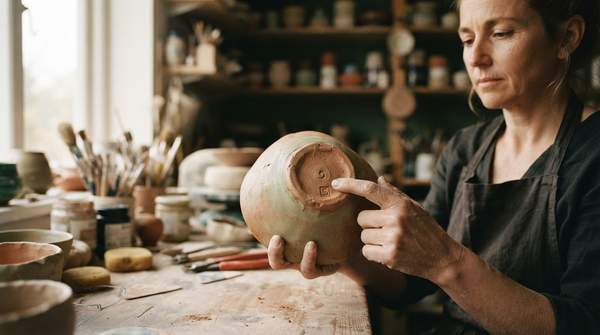
Earthenware is the oldest of the three, a low-fired clay body that emerges from the kiln porous and soft-colored. The Western Australian Museum's conservation manual notes that firing between roughly 600 and 1100 °C produces a ware with more than 15 percent porosity and a natural palette of yellow, buff, grey, red, and brown. That porosity is the defining fact: unglazed earthenware will absorb water, so functional pieces are glazed to seal them, as the ceramics reference at Between Two Worlds explains.
Aesthetically, this is a material that wears its origins openly. BosilunLife's ceramics overview describes earthenware's porous nature and rustic look, often complemented by glazing for beauty and durability. It lacks the strength of stoneware, which makes it better suited to decorative pieces and select tableware than to hard daily use.
That very imperfection is what rustic interiors celebrate. House Beautiful's style guide characterizes rustic design as embracing rough textures, natural materials, and earthy palettes, with an emphasis on handmade or artisanal items and the craftsmanship behind them. An earthenware bowl, with its slightly porous body and hand-glazed surface, answers that brief precisely.
Exploring Stoneware: Durability and Versatile Aesthetics
Stoneware is the workhorse. Fired high, at 1200–1300 °C, it vitrifies: the clay body fuses into a dense, non-porous material that can carry liquids without a glaze. The Between Two Worlds guide notes that stoneware vitrifies well at mid-to-high temperatures but rarely reaches zero porosity, while porcelain does.
Visually, stoneware is harder and heavier than earthenware, often reading as more rustic than porcelain, according to the CARRON comparison of the three types. Its robust body accepts a wide range of glazes, which is where its design flexibility comes from: a matte, speckled stoneware vase suits a farmhouse table, while a smooth, dark-glazed piece sits comfortably in a modern room. That same robustness makes it the natural choice for everyday cooking and storage.
For interiors, stoneware is the safe and versatile middle path—durable enough for daily life, textured enough to feel handmade, and finishable enough to lean rustic or contemporary depending on the glaze.
Discovering Porcelain: Elegance, Translucency, and Refinement
Porcelain is composed of fine clay and minerals fired at high temperatures—around 1200 °C, or cone 6–10 in kiln terms. Because of its high feldspar and kaolin content, it vitrifies almost completely, yielding a body with near-zero water absorption, often under 1 percent, as the Between Two Worlds vitrification guide explains. The result is a naturally waterproof, hygienic material that becomes translucent when thrown thin enough.
BosilunLife credits porcelain with translucency, delicate beauty, exceptional strength, and resistance to moisture—ideal for refined tableware and ornaments, though its production is energy-intensive compared with stoneware. CARRON's comparison calls it fine, translucent, and delicate, typically used for refined tableware and ornaments.
Where does it belong? MySpinShop's style guide argues that minimalist and Japandi interiors reward matte or satin porcelain finishes, because high-gloss porcelain competes with those styles' quiet warmth, while traditional and classic rooms are porcelain's natural home. The lesson: even within one material, the glaze finish must echo the room's temperament.
Pottery Type Comparison for Interior Design
Use this table to map each pottery type's material facts to the design styles they complement. The logic runs from property to finish to style: porosity invites rustic warmth, vitrification invites versatility, and translucency invites refinement.
| Pottery Type | Key Properties (Firing Temp, Porosity, Durability) | Common Finishes & Textures | Ideal Interior Styles |
|---|---|---|---|
| Earthenware | Low-fired (600–1100 °C); porous (over 15% porosity); less durable than stoneware or porcelain | Unglazed or glazed; richly glazed with a wide colour range; rustic, earthy textures | Rustic and artisanal styles that value natural materials and handmade character |
| Stoneware | High-fired (1200–1300 °C); vitrified, dense, non-porous; strong and durable | Hard, heavier body; finishes from matte to glossy, often earthy or speckled | Versatile: modern, farmhouse, and transitional rooms, depending on finish |
| Porcelain | High-fired (around 1200 °C); vitrifies almost completely, under 1% water absorption; exceptionally hard | Fine, smooth, often glossy; translucent when thin; allows intricate detail | Minimalist and traditional spaces; matte or satin finishes suit Japandi and minimalist rooms |
The reasoning behind each row: earthenware's porous body and hand-glazed surfaces align with rustic design's embrace of rough textures and artisanal craft. Stoneware's vitrified strength supports diverse glazing, letting one material serve many aesthetics. Porcelain's translucency and pristine surface complement the sophistication and clean lines of minimalist and traditional interiors—provided the glaze finish matches the room's mood.
Why the Pairings Work: The Aesthetic Principles
Artisanal interiors, as Cortney Gillett writes for Rocky Mountain Hardware, feature imperfect finishes, tactile textures, and one-of-a-kind pieces; their beauty lies in authenticity and the emotional connection between maker and homeowner. Earthenware, with its porous clay and visible hand, is that philosophy made solid. Porcelain, by contrast, thrives where restraint governs: MySpinShop notes that in minimalist rooms a porcelain piece can serve as the focal point, while in Japandi spaces matte finishes align with the style's wabi-sabi philosophy. Stoneware sits between the two, its adaptability stemming from its robust body and the variety of aesthetic treatments it can receive.
These recommendations are guidance grounded in established design principles, not strict rules. A glazed earthenware piece can certainly live in a modern room, and a porcelain vase can soften a rustic shelf—the pairings simply describe where each material's properties work with, rather than against, the room.
Making Your Pottery Choice: An Aesthetic Decision
Select pottery based on its material properties and finish to intentionally complement your interior design style. In practice: choose earthenware for a rustic look, stoneware for durability and finish-driven flexibility, and porcelain for a minimalist or traditional space—favoring matte or satin porcelain in quiet, restrained rooms. The measurable indicator of success is the visual harmony and coherence of pottery pieces within a chosen interior design style: when a piece stops fighting its surroundings and starts defining them, the pairing is right. This guide covers only the three most common types—earthenware, stoneware, and porcelain—and does not address specialized wares like raku or terracotta, nor where to buy or how to make pottery.
Sources
- 5 Interior Design Styles That Love Handcrafted Porcelain - MySpinShop
- Ceramics — MANUAL
- What is Vitrification in Ceramics? A Complete Guide — Between Two Worlds - Built to be held. Made to last.
- Ceramics: Definition, Materials and Properties — BosilunLife
- 27 interior design styles that show there’s more than one way to decorate — House Beautiful UK
- Earthenware, Stoneware, Porcelain: How to Tell Them Apart — CARRON