Authentic American Art Pottery from the late nineteenth and early twentieth centuries is identified through three physical examinations, performed in order: turn the piece over and read its maker's mark, analyze the glaze for depth and character, and assess the form against known studio styles. The bottom of a piece, as collectors who have spent years identifying American pottery attest, tells you more than the glaze does. Working through these three steps—then verifying what you find against authoritative references—lets a beginner determine the most likely maker of a piece, or conclude that it is unmarked, and understand what to do next.
The Foundation of Identification: Marks, Glaze, and Form
American Art Pottery emerged from the Arts and Crafts movement's conviction that handcrafted objects deserved a place in daily life, and its makers—firms like Rookwood, Weller, Van Briggle, and Grueby—each left signatures not only in ink and clay but in surface and silhouette. Identification therefore rests on three coordinated clues rather than any single one. The mark, when present, names the maker outright; the glaze and form confirm or stand in for that name when the mark is faint, worn, or absent. Importantly, an unsigned piece is not a worthless one. As the auction specialist Greg Myroth notes, unsigned pieces with strong design and glaze can be highly collectible—plain, well-resolved forms from recognized makers often outperform elaborate decorative pieces from the same period.
American Art Pottery Identification Framework
The framework below sequences the diagnostic process. Follow it top to bottom for any piece you encounter: check the bottom first, then the surface, then the shape, and finally turn to the reference materials that verify what your eyes have found.
| Step | What to examine | Key finding | What it establishes |
|---|---|---|---|
| 1. Examine the bottom | Underside of the piece in raking light | Impressed, ink-stamped, or raised script marks; the most information-rich area | Likely maker, if marked; a starting point if not |
| 2. Analyze the glaze | Surface color and texture | Depth and richness of color, velvety matte surfaces, unusual effects such as crystalline, iridescent, or oxblood glazes | Studio character and quality; supporting evidence when marks are absent |
| 3. Assess the form | Overall shape, handles, body | Characteristic silhouettes; certain makers are known for elaborate or intricate handles | Attribution of unmarked pieces; consistency check on marked ones |
| 4. Verify and value | Reference works and valuation services | Mark dictionaries, collector's guides, auction estimates, formal appraisals | Confirmed maker and appropriate next step for valuation |
Step 1: Examine the Bottom for Maker's Marks
Watch an experienced collector in a shop and you will see the same ritual: every piece gets turned over. Collectors do this because the bottom tells more than the glaze on most American pottery. Marks appear in several forms—impressed into the clay, ink-stamped, or raised in script—and each studio had its own conventions. Van Briggle used a conjoined double A inside a square with "Van Briggle" and often a date, though undated later pieces are far more common than dated early ones. Weller impressed or ink-stamped its name, sometimes as "Weller Pottery" in script. Fulper used a vertical racetrack-shaped ink or impressed mark.
Condition matters as much as presence. Raised script marks on reproductions are usually softer than those on originals, so the crispness of the mark should be consistent with the wear on the rest of the piece. Photograph the whole base in raking light—light angled across the surface to reveal shallow impressions—which is exactly what Revere Auctions asks owners to submit with a piece's height when seeking a free identification and estimate.
Authoritative Resources for Mark Verification
A mark found is not a mark read; verification requires the references that experienced collectors rely on. The Marks Project maintains a searchable dictionary of marks, signatures, and artist listings covering American studio pottery from 1946 to the present, and explicitly encourages visitors to use it to identify marks. For the earlier art pottery era, print references remain standard: Art Pottery of the United States: An Encyclopedia of Producers and Their Marks, the Kovels' Collector's Guide to American Art Pottery—a collector's guide to makers, marks, and factory histories—and Warman's American Pottery & Porcelain are all cited in the University of North Texas libraries' research guide for identifying and valuing ceramics.
Dick Sigafoose's American Art Pottery: Identification & Values covers major and minor producers with historical context. No article can reproduce a complete mark dictionary, so these works are the intended endpoint of the search.
Step 2: Analyze the Glaze Characteristics
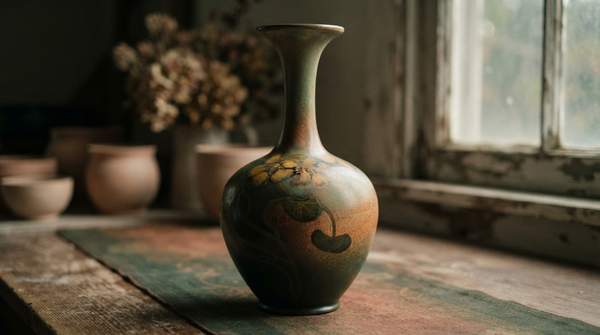
Where the mark names the maker, the glaze reveals the philosophy. The velvety matte surface is the defining characteristic of Arts and Crafts pottery, and Myroth advises collectors to look for depth and richness of color above all. Unusual or experimental effects—crystalline, iridescent, or oxblood glazes—signal a studio working at the edge of its craft, where the most sought-after pieces were made. Application quality is a diagnostic in itself: an even coat without flaking or heavy wear indicates both careful making and careful keeping. Condition significantly affects value, so a glaze that has been chipped, reglazed, or heavily abraded changes not just the identification picture but the worth of the piece. When a mark is absent, glaze character becomes the strongest secondary clue to origin.
Step 3: Assess the Form and Style
The third pass is the quietest: hold the piece at arm's length and read its silhouette. Certain makers are known for characteristic forms—elaborate or intricate handles in particular—and comparing the overall shape, body, and handles to documented examples helps attribute pieces that carry no mark at all. Crafted Auctions maintains a searchable archive of past results where pieces similar in form, glaze, and condition can be found, turning form comparison into a concrete research exercise. Two cautions from the same specialist discipline the eye: age alone does not mean value—maker, design, and demand matter more—and decorative complexity is not the same as collector value. A plain, well-resolved form from a recognized maker often outperforms an ornate one, and an old appraisal may not reflect what buyers are paying today.
Understanding Valuation: Estimates vs. Appraisals
Once a piece is identified, valuation splits into two documents with different jobs. A free auction estimate, which Revere Auctions offers alongside identification, gives an indicative market value—what a piece is likely to bring at auction, where art pottery does best because collectors bid against one another. It is an informal assessment, not a legally binding valuation, and the firm advises requesting it first if you are unsure which you need. Unmarked pieces are harder to sell at the top of a maker's range but are not worthless.
A formal written appraisal is a different instrument: a signed document stating a value for a stated purpose—insurance, estate settlement and probate, or a charitable donation. It is a paid service written to a higher standard of value, auditable by outside parties, and insurance appraisals normally come in higher than the auction estimate for the same piece. According to LLB Auction's guidance, five situations require a signed report: insuring a work, settling an estate, dividing property in a separation, substantiating a charitable donation, and defending a value to a tax authority. The IRS, in Publication 561 as revised December 2025, requires a qualified appraisal for noncash charitable deductions above $5,000, requires the appraisal attached to Form 8283 for art valued at $20,000 or more, and permits a Statement of Value review for art appraised at $50,000 or more.
Next Steps: Verifying and Valuing Your American Art Pottery
After identifying key characteristics, use authoritative resources to verify marks and consider the appropriate type of valuation based on your needs. The measurable indicator of success is straightforward: either you have verified a mark against a listed resource—The Marks Project's dictionary, the Kovels' guide, or the producers' encyclopedia—or you clearly understand whether your situation calls for a formal appraisal rather than an estimate. If you are insuring a piece, settling an estate, or claiming a donation above the IRS thresholds, the signed appraisal is the only document that works; if you are simply wondering whether to sell, photograph the base in raking light, note the height, and request a free estimate.
Sources
- Identifying American Pottery - Look at the Bottom — CAJUNC
- Guides: Art Sources for the Identification and Valuation of Fine and Decorative Art: Ceramics, Porcelain & Glass
- How Do I Know If My Pottery Is Valuable? — Crafted Auction
- American Art Pottery Marks: How to Identify Your Pottery — Revereauctions
- The Marks Project - A Marks Dictionary of American Studio Pottery, 1946 to Present — Themarksproject
- American Art Pottery: Identification & Values, 2nd Edition: Sigafoose, Dick: 9781574324839: Amazon.com: Books
- What Is My Art Worth: Estimate or Formal Appraisal — LLB Auction