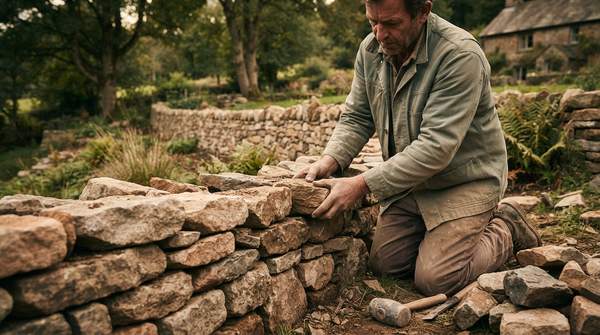
A dry-stack stone wall stands or falls on a handful of placement rules, not on mortar. According to The Stone Trust, an organization devoted to dry stone walling, the basic techniques needed to build a strong wall can be condensed into a few rules—and if you follow them, your wall will be strong and good looking. The most common failure, a placement error called "tracing," is one of the primary reasons walls fall down. Here is what you need to know before you lift your first stone.
Understanding Dry-Stack Stone Walls: Principles of Durability
Dry-stack construction is a distinct craft from masonry. As The Stone Trust's guide—written and drawn by Brian Post, a Master Craftsman with the Dry Stone Walling Association of Great Britain—explains, dry stone wallers have their own vocabulary and terminology, and their walls rely entirely on gravity, friction, and interlock rather than any binding agent. That is why placement discipline matters so much: every structural duty a mortar joint would perform must instead be carried by how each stone is set.
The good news for a DIY builder is that the craft's essentials are few and learnable. The Stone Trust reduces the core techniques to five basic rules, and a companion set of ten rules from Pebble Junction, a Florida stone supplier, echoes the same principles. Where the two sources overlap—footing, jointing, batter, and through-stones—you can treat the guidance as settled craft knowledge rather than one writer's opinion.
One boundary before you begin: this guidance suits garden and landscape walls of modest height, typically up to about three to four feet. Taller walls, or walls that must support critical loads, call for engineering advice beyond these craft rules. Local building codes, which vary by jurisdiction, are a separate check you should make before digging.