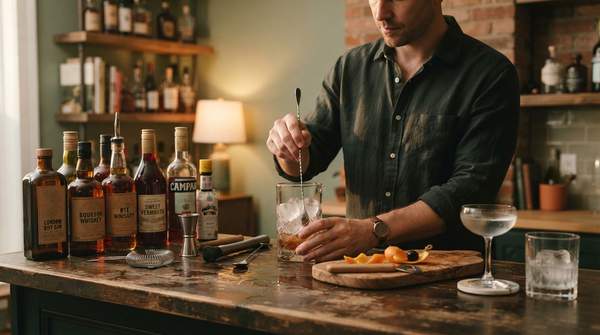
A classic home bar does not require a walk-in cellar or a hundred bottles. It requires a small, deliberate set of spirits, a few honest tools, and the right glasses — a kit assembled not for show but for the drinks it makes possible. I've come to think of it the way a cook thinks of a knife roll: every item earns its place by what it lets you do. Guides from Distiller, TheBar, and home-bar writers converge on a surprisingly short list, and this piece distills their advice into one tiered checklist, then shows you the cocktails it unlocks.
Tier 1: Must-Have Spirits for Versatility
The foundational question is simple: which bottles let you pour the widest range of classic drinks? TheBar's home-bar guide names the five classic types of liquor a well-stocked bar cart should hold — rum, vodka, tequila, whiskey, and gin — defining each by its base: rum from sugar cane or molasses, vodka from potatoes or grains, tequila from agave, whiskey as a grain spirit aged in barrels, and gin as a clear botanical spirit flavored with juniper.
For the classic repertoire, two of these carry the most weight. Whiskey — bourbon or rye in most guides' framing — anchors the Old Fashioned and the Manhattan. Gin, meanwhile, is the backbone of the Gin & Tonic and the Martini, the drinks that most often introduce guests to a home bar's capabilities. The remaining three rounds out your range without demanding brand-name splurges; you are buying categories and styles here, not labels, since Distiller's bottle guide explicitly notes its own product picks are just examples to be substituted by preference. This is a curated beginner's list, not an exhaustive one — no tiki rum wall, no absinthe fountain.
Essential Bar Tools: Your Cocktail Crafting Arsenal
Tools are where beginners most often overspend or under-buy, and the experts' advice is refreshingly modest. A cocktail shaker to chill and combine ingredients, a jigger for precise measurement, and a strainer to hold back the ice form the core toolkit that nearly every mixed drink passes through. Distiller's guide strikes a pragmatic note: in a pinch, you could shake with a mason jar and stir with a spoon, but it urges investing in a jigger or small measuring cup with a spout "at the very least."
Holy City Handcraft's complete home-bar guide, written by a working mixologist, makes the same point from the other direction: there are "thousands of beautiful varieties of tools out there that serve the same purpose." Elegance in a bar comes from consistency, not chrome. A plain shaker that gets used every Friday night is worth more than a gold-plated one that stays in its box.
Glassware Essentials: The Right Vessel for Every Drink
Two shapes cover nearly the entire classic canon. The coupe — a variation on the wine glass that has become, as A Few Cocktails puts it, "a signifier of not only tradition but of craftsmanship" — is the vessel for anything shaken or stirred and served up: a Martini, a Manhattan poured out of the mixing glass. Any high-end bar worth its salt, the same writer argues, keeps a coupe on hand, and so should you.
The rocks glass is its essential counterpart: the right home for an Old Fashioned, a whiskey on ice, or any short spirit-forward pour. With a few of each on the shelf, plus something tall for a Gin & Tonic, your glassware is functionally complete. TheBar suggests the finishing flourishes — a decanter for the whiskey, glass picks and stir sticks, fancy ice molds — as elevations rather than requirements.
Mixers and Garnishes: The Finishing Touches
This is where a bar turns from a bottle collection into a working kitchen. The Holy City Handcraft guide keeps a standing list: fresh citrus for juice and garnishes — limes, lemons, oranges — club soda, salt, clear ice cubes, simple syrup at a one-to-one sugar-to-water ratio, cherries, and fortified wine in the fridge, with the firm note that dry and sweet vermouth "always belongs in the refrigerator." Sparkling mixers, as TheBar observes, are the top-line choice for a proper gin and tonic or vodka soda.
Distiller's guide treats these pantry items as separate from the bottle list but equally non-negotiable: fruit, sugar, tonic and soda should be kept "on hand at all times." The practical takeaway is that half of cocktail-making is grocery shopping — fresh, cheap, and perishable, which is exactly why it gets skipped and exactly why it shouldn't be.
Your Classic Home Bar Starter Kit Checklist
The checklist below merges the recommendations above into one tiered shopping list. Every row links an item to its functional purpose — the drink or job it makes possible — so you can see, before you spend a dollar, what each purchase earns you. The tiers separate the must-haves from the nice-to-haves that can wait until the basics are in service.
| Category | Item | Purpose / Key Cocktails | Tier |
|---|---|---|---|
| Spirits | Whiskey (bourbon or rye) | Old Fashioned, Manhattan, whiskey on the rocks | Essential |
| Spirits | Gin | Gin & Tonic, Martini | Essential |
| Spirits | Rum, vodka, tequila | Widens the range of classic drinks; types vary (light/dark rum, agave tequila) | Essential for a full classic bar; add incrementally if budget is tight |
| Tools | Cocktail shaker | Chilling and combining ingredients | Essential |
| Tools | Jigger (or measuring cup with spout) | Precise measurement — Distiller calls this the minimum investment | Essential |
| Tools | Strainer | Separating ice from the finished drink | Essential |
| Glassware | Coupe or Martini glass | Shaken or stirred drinks served up: Martini, Manhattan | Essential |
| Glassware | Rocks glasses | Old Fashioned and short spirits-over-ice pours | Essential |
| Glassware | Highball/tall glass | Gin & Tonic, vodka soda | Essential |
| Mixers | Dry and sweet vermouth (refrigerated) | Manhattan, Martini | Essential |
| Mixers | Fresh citrus (lemon, lime, orange), simple syrup | Juice, balance, and garnish across the repertoire | Essential |
| Mixers | Club soda, tonic, salt, cherries, clear ice | Top-shape sparkling drinks and finishing touches | Essential pantry |
| Extras | Decanter, glass picks, stir sticks, ice molds, garnish dish | Presentation and hosting polish | Nice-to-have |
Notice how few rows are truly load-bearing: one whiskey, one gin, the three core tools, two glass shapes, and a refrigerator stocked with vermouth and citrus account for almost everything the classic canon asks of you. The nice-to-haves can arrive one birthday at a time.
Your First Cocktails: Putting the Kit to Use
A checklist only proves itself when the bottles come out, so here is the repertoire your kit was built around. The Old Fashioned needs whiskey, a rocks glass, sugar or simple syrup, and bitters-forward garnish — the whole drink fits in your palm. The Manhattan pairs whiskey with sweet vermouth, stirred and served up in the coupe. The Gin & Tonic is gin, good tonic, ice, and citrus in a tall glass — the drink TheBar singles out sparkling mixers for. And the Martini is gin and dry vermouth, the cleanest test of whether your vermouth is fresh; if it's been sitting out, this is the drink that tells you.
With rum, vodka, or tequila added, the same pantry stretches further — a Mojito with mint, a Daiquiri with lime and simple syrup, a Margarita once tequila joins the shelf. Each new bottle multiplies the drinks the citrus and syrup already support, which is the quiet logic of the starter kit: the small items do the heavy lifting.
Ready to Mix: Your First Classic Cocktails
With the essential spirits, tools, and glassware acquired, the reader can confidently begin crafting foundational classic cocktails like the Old Fashioned, Manhattan, Gin & Tonic, Martini, Margarita, and Daiquiri. The measure of success is straightforward: the ability to successfully prepare and serve at least three distinct classic cocktails from the core repertoire using the purchased items. Host one evening, shake or stir three different drinks for three different tastes, and keep the vermouth in the refrigerator where it belongs. That is the whole craft, begun.
Sources
- Home Bar Guide: Essential Bottles to Stock for Every Budget — Distiller - The Liquor Expert
- 4 Easy Steps to Create an Impressive Home Bar | The Bar — TheBar
- The Complete Guide to Building Your Home Bar — Holy City Handcraft
- Home Bar Essentials — A Few Cocktails