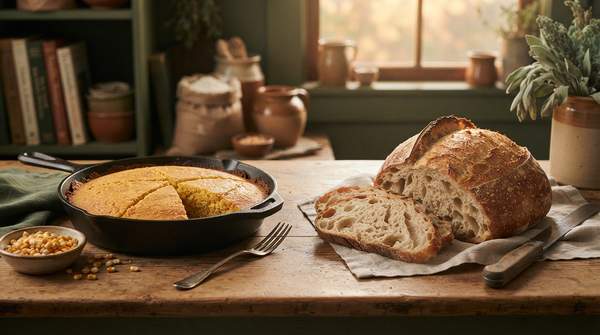
Southern cornbread and San Francisco sourdough are both foundational American artisanal breads, yet they could hardly have arrived by more different roads. Cornbread descends from pre-colonial Native American cooking with a grain native to the Americas; San Francisco sourdough is an Old World fermentation technique that found its American identity in a single 19th-century event, the California Gold Rush of 1849. Understanding each tradition means understanding that "artisanal" describes not one method but two very different relationships between hands, grain, and time.
Introduction: Two American Artisanal Bread Traditions
When we speak of American artisanal bread, we are really speaking of at least two inheritances braided together. One runs through the indigenous agriculture of the South, where ground corn became daily bread long before Europeans arrived. The other crossed the ocean with European bakers and collided with the Gold Rush, where wild yeast starters earned miners the nickname "sourdoughs." Placing these traditions side by side reveals something isolated histories cannot: American bread is not a single story of European technique transplanted, but a conversation between native ingredients and imported methods.
Southern Cornbread: A Legacy of Indigenous Grains
Native Americans were the first to grind corn into meal and make simple breads from it, a practice early European settlers in the South adopted and adapted, as Trace Barnett recounts for Alabama Public Television. In its earliest form, cornbread was strikingly austere—cornmeal, water, and sometimes salt—easy to make where yeast-based European loaves were not. Over generations, as buttermilk, eggs, and chemical leavening became widely available, cornbread evolved into the skillet-baked dish recognized today.
Its variations preserve that older austerity. Corn pone, a rustic fried or baked form, uses little more than cornmeal and water; hot water cornbread is shaped into rounds and fried crisp. Even the region's famous sugar debate is a story of changing grain: modern commercial cornmeal is more finely milled and less naturally sweet than stone-ground predecessors, which led some cooks to compensate with added sugar.
San Francisco Sourdough: A Gold Rush Innovation
Sourdough itself is ancient. Wall paintings and analyses of desiccated bread and beer remains show the ancient Egyptians baking leavened bread with sourdough, as Dr Vanessa Kimbell notes in her history of the bread. Wild yeast cultures have flavored food preparations worldwide since long before written records.
The distinctively American chapter opens in 1849. According to Saveur's history of American bread, Boudin Bakery opened in San Francisco that year and began producing the first San Francisco sourdough using a starter borrowed from local gold miners—and the bakery still uses that same starter today. Kimbell likewise points to evidence of continuous production since 1849, with miners nicknamed "sourdoughs" after their bread. The bread's fame, in other words, is welded to a specific place and moment.