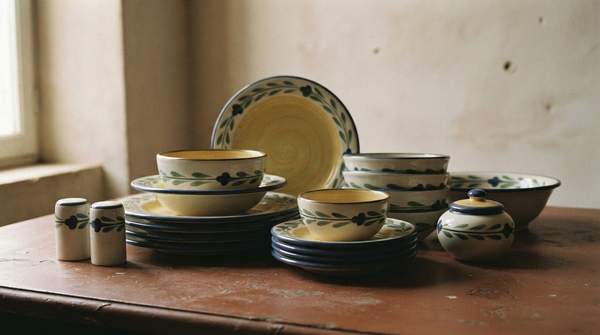
American dinnerware underwent a transformation between the nineteenth century and the mid-twentieth century that mirrors the country's own: what began as imported European porcelain, displayed to signal wealth and refinement, became domestically mass-produced earthenware designed to be used every day. The clearest bookends of that shift are the White House china of 1891—288 pieces of French-made porcelain costing $732.00—and Russel Wright's "American Modern" line, which stayed in production from 1939 to 1959 and was built to be cheap, casual, and customizable. Understanding how the table got from one to the other means understanding how American home life itself changed.
From European Elegance to American Identity: 19th-Century Dinnerware
In the nineteenth century, fine dinnerware in America was largely a European product. The White House Historical Association records that the presidential china service ordered in 1891 was manufactured by Tressemannes & Vogt of Limoges, France, and that the 288-piece set cost $732.00, arriving at the White House that December. The choice of a French manufacturer was not incidental: the era's most prestigious tableware came from European porcelain centers, and American institutions participated in that prestige by buying it.
The function of this china was as much theatrical as practical. Until the twentieth century, according to the White House Historical Association, the presentation of desserts—a sprawling final course of sweets, fruits, ice creams, and nuts—was a "signifier of a host's sophistication and social status." Elegantly decorated porcelain baskets, coolers, and china sets were needed to stage what the Association calls this "key and often breathtaking last course," and most presidential china services ordered in the nineteenth century included a dessert service. The dishes were props in a performance of refinement.
This was a world of imported luxury with deep roots. Heather Roberts, writing for The Square PHX, notes that George Washington himself collected porcelain, including a blue-and-white tableware set he received in April 1763. But for most people in the American colonies, porcelain dishes were a luxury good because of the price of shipping and the fragility of the cargo. The economics of the china cabinet kept fine dinnerware confined to households that could afford both the purchase and the risk.
The consequence was that formal dinnerware remained inaccessible to the general public. A set costing hundreds of dollars in 1891 was far beyond ordinary reach, and its use was reserved for formal occasions—state dinners, elaborate entertaining, staged dessert courses—rather than daily meals. The china cabinet, not the kitchen shelf, was its natural habitat.