Every hand-thrown pot is the survivor of a long, unforgiving sequence. Between the raw lump of clay and the glazed vessel that holds food on a table, the material must be wedged, centered, pulled, dried twice, fired twice, and coated in liquefied glass—and a single misjudgment at any stage can undo weeks of work. Potters themselves describe the process as one that "may take weeks from start to finish," during which the piece shrinks by roughly 10 to 12 percent from its wet state to its final glazed form. Understanding that sequence is the key to appreciating why artisanal pottery carries the time and price it does.
The Journey Begins: Preparing the Clay
Before clay ever touches the wheel, it must be worked in a process called wedging, which reduces the number of air pockets in the clay and creates a uniform texture. The technique is ancient—the same method of pot formation was used by ancient Greek potters when they made their vases, as Jeff Gingras and Debby Sneed of the University of Colorado's Department of Classics explain—and it remains non-negotiable today.
The potter Tom Humphries of The Little Pot Company is blunt about the stakes: "Working with badly prepared clay makes the job of throwing pottery much harder." If the clay is softer and more watery in some parts than others, it may go thin unexpectedly during throwing, and it will dry at different rates, which can cause cracking. He describes needing only a little kneading to homogenize his clay and ensure no trapped air—though potters generating waste clay typically recycle their scraps, often in a lidded bucket for later reuse.
Shaping on the Wheel: Throwing the Form
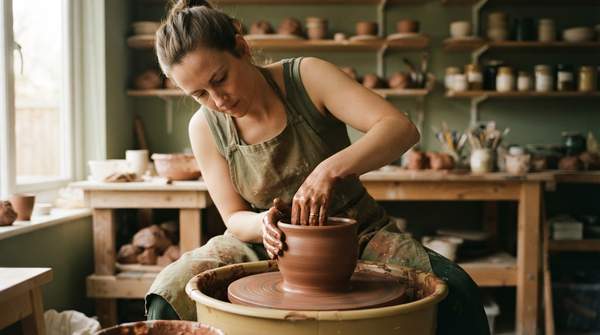
With the clay prepared, the wet lump is thrown onto the center of the wheel so that it maintains contact with the wheel head while the wheel is in motion. The wheel then spins at varying speeds, depending on the potter's needs at each moment. The first and most demanding task is centering: wetting the clay and hands, spinning the wheel fast, and pushing from the top and the sides until the clay is perfectly centered on the turning wheel.
Centering looks effortless and is not. As the stoneware studio Evolution Stoneware Pottery puts it, "Centering the clay can be very difficult." The shape of the vessel is controlled entirely by how the potter pushes on it with the hands. Once centered, the clay is opened and the walls are "pulled" upward—the method used to raise the sides—gradually drawing the mass outward and up into a defined vessel.