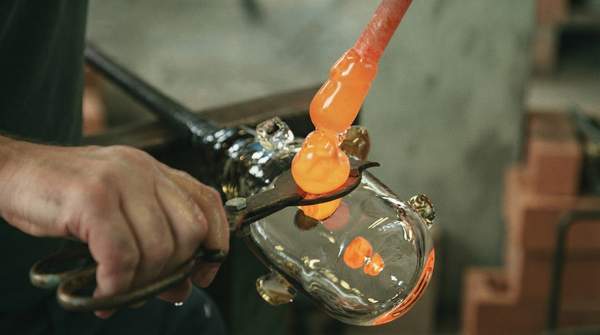
Hand-blown glass begins as a pool of molten material held above 2,000 degrees Fahrenheit and ends, more than half a day later, as a cooled object resting in an annealing oven. Between those two points, the glassblower repeats a rhythm of gathering, shaping, inflating, and reheating, working against a material that stiffens within moments of leaving the heat. The process, which practitioners trace back to the first century B.C., follows a sequence that has changed remarkably little: melt the glass, gather it on a blowpipe, shape it, blow it, refine it, and cool it slowly enough that it survives.
The Molten Beginning: Heating and Gathering
Everything starts in the furnace. Jack Pine Studio, an Ohio glass workshop, describes raw materials melting at scorching temperatures until the batch reaches a honey-like consistency above 2,000 degrees Fahrenheit, with careful heat management at this stage laying the foundation for everything that follows. Epiphany Glass, a Michigan studio, keeps its main furnace—a tank holding roughly 800 pounds of clear glass—running continuously between 2,000 and 2400 degrees, because the ceramic-lined unit takes about six days to reach temperature and weeks to recover if it fails.
Once the glass is molten, the artist gathers it by inserting one end of a blowpipe—a hollow metal tube—into the furnace and rolling it through the liquid until a "gob" of glass attaches, as described in DMG School's step-by-step account. The gather is the raw mass from which the entire piece will grow, and its uniformity matters from the first moment.
Initial Shaping: Marvering and Blocking
The glowing gob is immediately rolled across a marver, a flat steel slab that does two jobs at once: it draws excess heat out of the glass and lets the artist shape it. Moana Glass, a studio that teaches the craft, explains that rolling molten glass across the marver creates symmetry and smoothness, and that the surface removes enough heat to allow precise refinement of the form.
Before the glass is inflated, wooden blocks also come into play. These tools are soaked in water beforehand, and as DMG Gallery describes, the water creates a layer of steam between the wood and the glass, letting the blower smooth the material into a sphere without sticking. Larger gathers call for larger blocks, since each additional gather increases the volume of glass substantially.