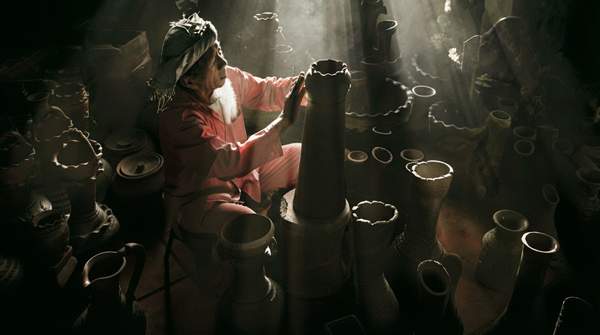
In the village of Bau Truc, in Ninh Thuan province, Cham women shape clay into jars, pots and ritual objects without a potter's wheel or a mould. The craft, inscribed by UNESCO in November 2022 on its List of Intangible Cultural Heritage in Need of Urgent Safeguarding, is one of Southeast Asia's oldest pottery traditions, and its survival now depends on a race between declining artisan numbers and a new wave of community-based tourism and training initiatives.
The Ancient Art of Bau Truc Cham Pottery: A Wheel-less Tradition
Bau Truc lies about ten kilometres south of Phan Rang - Thap Cham city, a small village of more than 500 families, of which roughly 85 percent still practice the pottery trade, according to Vietnam's national tourism authority. The village carries a pottery tradition that local reporting places at around 300 years old, and its style is said to be handed down from Po Klong Chan, an ancestral figure of the Cham people.
What distinguishes the village's output is not scale but method. Every vessel is shaped by hand, with artisans working clay, water and fire into finished pieces using knowledge passed from mother to daughter across generations. Children in the village grow up watching their mothers and grandmothers select and prepare clay, shape products, decorate them and fire them, a cycle of transmission that elders hope will continue among younger generations.
Step-by-Step: The Traditional Bau Truc Pottery Process
The making of a Bau Truc pot follows a sequence that has remained essentially unchanged for centuries. It begins with the clay itself, which is sourced from the village's surrounding areas and carefully selected and processed using traditional techniques. Artisans knead the clay to prepare it, though detailed accounts of cleaning or mixing steps are not part of the available record.
From there, the work moves to shaping. Without a wheel, artisans turn the clay by hand, using simple tools such as anvils, bamboo circles and shells to coax the vessel into form. Cham women play the central role in shaping and embellishing the ceramics, bringing intricate patterns characteristic of Cham culture onto each piece. The decorated vessels are then dried naturally in the sun before the final stage: an open-air firing using firewood and straw, which produces the pottery's naturally vibrant colours and its distinctive reddish-brown hue.
The Wheel-less Craft: A Bau Truc Pottery Explanatory Model
The table below deconstructs the traditional process into its distinct stages, showing the technique or action at each step and what makes that stage characteristic of the wheel-less Bau Truc method.
| Stage | Technique / Action | What Defines It |
|---|---|---|
| Clay sourcing & preparation | Clay is sourced from around the village, carefully selected, then kneaded using traditional techniques | The unique local clay is the foundation of the pottery's distinct character |
| Hand-shaping | Clay is shaped entirely by hand, without a potter's wheel or mould | Simple tools — anvils, bamboo circles and shells — replace the wheel |
| Decoration | Vessels are embellished with intricate, unique patterns | Motifs reflect Cham cultural and spiritual elements; the work is largely done by Cham women |
| Drying | Shaped pottery is dried naturally in the sun | A traditional, natural drying method requiring no equipment |
| Open-air firing | Products are fired outdoors with firewood and straw | The firing yields naturally vibrant colours and the reddish-brown hue typical of Bau Truc ware |
Read stage by stage, the model shows why each piece is considered a work of art rather than a mere functional object: at no point does the artisan surrender control to a machine, and every surface bears the mark of a hand guided by inherited knowledge.
Cultural Heartbeat: Significance of Bau Truc Pottery to the Cham Community
For the Cham, Bau Truc pottery is inseparable from daily life and belief. The range of products runs from everyday household items — jars, pots, pans and kettles — to religious objects, statues, reliefs and decorative pieces, with designs that often depict natural scenes and spiritual motifs embodying the community's connection to its environment. One practical virtue endures: water jars from the village are popular in hot, dry regions because they keep water roughly one degree cooler than the ambient temperature.
Quang Thuc Doan, chairman of the Ninh Phuoc commune People's Committee, has stressed that Bau Truc pottery represents far more than clay products, carrying the craftsmanship, daily life, beliefs and spirit of generations of Cham people. The vessels embody folk knowledge, customs, memories and cultural identity — which is why the 2022 UNESCO inscription was framed locally not as an honour alone but as a call to ensure the craft continues to be practised, passed down and valued in contemporary life.
Challenges to Preservation: Threats to a Living Heritage
The threats facing the village are concrete and compounding. The number of skilled artisans is dwindling, and the younger generation shows little interest in pursuing the traditional craft. Raw materials are becoming scarce, production space is limited, and rising production costs combined with competition from industrial ceramics further threaten the heritage's survival. Many elderly artisans continue to pass on their skills despite their advanced age — a sign of dedication, but also of a demographic cliff.
The UNESCO listing itself signals the urgency: the category of heritage "in need of urgent safeguarding" is reserved for traditions whose viability is at risk. Dr. Pham Cao Quy, of the Department of Cultural Heritage under the Ministry of Culture, Sports and Tourism, has noted the importance of understanding the true meaning of that designation — that recognition obliges active protection, not celebration alone.
Sustaining the Craft: Preservation Initiatives and Community Engagement
The responses now underway work on two fronts: keeping the skills alive and making the craft economically viable. Nearly four years after the UNESCO recognition, heritage protection efforts have yielded results including training courses, the honouring of artisans, brand building, festivals and infrastructure investment. Workshops and pottery classes have been introduced specifically to attract younger generations, and the village has integrated cultural tourism into the traditional craft, letting visitors experience the pottery-making process firsthand rather than simply buying finished wares.
The most structured intervention is a project approved by the Ministry of Culture, Sports and Tourism titled "Developing a Heritage-Linked Model Integrated with Tourism Journeys to Support Ethnic Minority Communities with Shared Heritage." It aims to connect intangible cultural heritage with tourism for sustainable development, integrating Bau Truc's traditional Cham crafts with other heritage-tourism sites such as the My Nghiep weaving village. Tourists can directly participate in pottery making — selecting clay, shaping, decorating and firing — and longer stays create opportunities for increased spending and expanded income for local people, while artisans gain cultural exchange, skill-sharing and market reach beyond the local area.
Sustaining a Legacy: The Future of Bau Truc Pottery
Continued support for community-based tourism and artisan training is crucial to ensure the survival and economic viability of Bau Truc Cham pottery. The evidence points to a clear test of whether that support is working: increased participation of younger generations in pottery making, and a rise in visitor engagement with the craft. Those two indicators — apprentices at the anvil and tourists at the firing ground — will show whether a tradition carried for three centuries by hand alone is handed safely to the next pair of hands.
Sources
- Bau Truc Pottery Village, the quintessence of Cham culture — Vietnam Tourism
- Bau Truc Pottery Village - A Living Tradition of Cham Art and Culture — Vietnam
- Preserving Bau Truc pottery heritage in modern life — Vietnam+ (VietnamPlus)
- Creating sustainable vitality for the Bau Truc Cham pottery heritage. — Vietnam
- Vietnam’s Bau Truc pottery village to become a model for community-based tourism — Asianews