If you want a culturally immersive American getaway where the car stays parked, look for two things above all: a cohesive architectural identity and a core built for feet rather than fenders. St. Augustine, Florida, and Santa Fe, New Mexico, are two of the country's most instructive examples—one a Spanish Colonial seaport town, the other an adobe city organized around a historic plaza—and comparing them side by side gives you a portable framework for judging any historic destination. This is not an exhaustive survey of walkable America; it is a close reading of two towns that, in very different materials and climates, solved the same problem beautifully.
Defining the Walkable Historic Town
Walkability is easy to fake and hard to build. A 2016 survey of walkable Southern towns by Emily Colin, published by ideal-LIVING, put it plainly: pedestrians need sidewalks, crosswalks, stoplights and signs, but "walkability is about much more than infrastructure. It's about creating a sense of community—the idea that there is someplace worth walking to, and people that you'd like to see when you get there."
That definition is the checklist I keep returning to when I evaluate a historic town. The infrastructure layer is the visible hardware—pedestrian-only streets, crosswalks, a compact district where sights cluster within a stroll of one another. The community layer is subtler: shops and cafés occupying historic buildings rather than displacing them, landmarks that sit inside the walking route rather than across a highway from it. When both layers are present, a town stops being a museum you visit and becomes a place you inhabit for a few days.
St. Augustine, FL: Spanish Colonial Charm
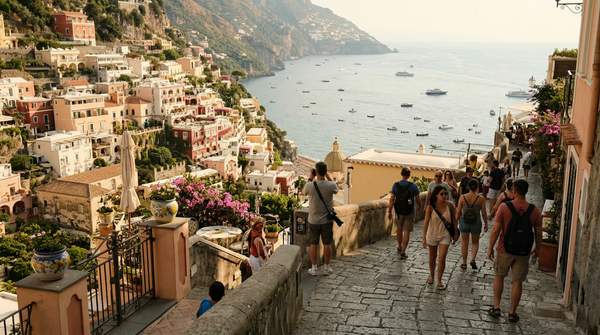
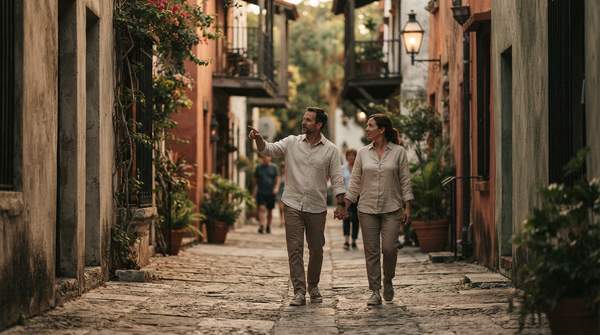
St. Augustine's historic downtown is the Florida model of the walkable historic town, and its appeal begins at street level. The travel writer Jasmine Alley describes a district that is "incredibly walkable, with cobblestone streets, Spanish-style architecture, and landmarks around nearly every corner," where you can spend days wandering on foot among museums, cafés and shops. The must-see stops she names—Castillo de San Marcos, the 17th-century waterfront fort, Flagler College, and St. George Street—are all reachable without a car.
The pedestrian experience has a deliberate centerpiece. As ideal-LIVING reported, "Bustling St. George Street, located in the center of the historic district, is for pedestrians only—no cars allowed," with the quieter historic Aviles Street as a low-key alternative. The same account notes the district's cobblestone streets, bed-and-breakfasts, pubs and eateries, the Castillo de San Marcos (a walk-in park and fortress standing since 1672), and the two-acre Colonial Quarter in the heart of the district. In April 2016, About.com's AboutTravel named it Florida's most walkable city.
None of this is accidental. The city's own planning department describes St. Augustine's history as "one of the city's most valuable resources" and maintains preservation tools that include architectural guidelines, demolition review, sign standards, and an archaeological preservation ordinance governing work that may disturb resources below the ground. The evidence supports an inference, though not a proven causal claim: a town with this apparatus is structurally committed to keeping its character intact, and visitors walk through the results.
Santa Fe, NM: Pueblo Revival Heritage
Santa Fe works differently, and the difference is instructive. Where St. Augustine compresses its charm into a compact seaport district, Santa Fe spreads a distinctive adobe aesthetic—its Pueblo Revival and Spanish Colonial architectural identity—across a high-desert city that Alley says you can experience fully "without a rental car." The city itself publishes suggestions for a first 72 hours and offers guided walking tours, a signal that pedestrian immersion is part of its official self-presentation.
The anchor is the Santa Fe Plaza, which Alley singles out as a great way to experience the city's rich history and architecture on foot. Around and beyond it, she notes, the city suits visits to historic sites like Native American ruins and centuries-old churches "teeming with tales of the past." The Plaza functions as the town's gravitational center: a defined public space where architecture, commerce and history converge, the desert counterpart to St. Augustine's fort-guarded harbor streets.
Comparing Distinct Historic Walkability Models
Set the two towns against consistent criteria and two distinct models of successful historic urban design emerge—one coastal and Spanish Colonial, one high-desert and Pueblo Revival. The table below is the comparative framework you can carry to any other candidate destination.
| Dimension | St. Augustine, FL | Santa Fe, NM |
|---|---|---|
| Primary Architectural Style | Spanish Colonial; cobblestone streets and Spanish-style architecture in the historic district | Pueblo Revival adobe identity, with centuries-old churches and Native American heritage sites |
| Key Walkable Areas | Pedestrian-only St. George Street; quieter historic Aviles Street; the compact historic district | The Santa Fe Plaza as central focal point; a city explorable without a rental car, with guided walking tours |
| Notable Historic Landmarks | Castillo de San Marcos (fortress since 1672), Flagler College, the two-acre Colonial Quarter | The Plaza itself; nearby Native American ruins and centuries-old churches |
Read the columns as two design philosophies. St. Augustine concentrates: a small, dense district where a car-free spine (St. George Street) stitches fort, college and shops into one loop. Santa Fe radiates: a plaza from which history disperses into surrounding sites, with the city's own tourism apparatus scaffolding the walker's itinerary. Both satisfy Colin's two-part test—infrastructure plus a reason to be there—but they distribute the "reason" differently, and that difference should shape your choice.
Evaluating Your Next Historic Destination
Here is the framework in practice, distilled from these two case studies. First, identify the town's primary architectural style and ask whether it is cohesive across the district or scattered among modern intrusions. Second, look for a dedicated pedestrian zone—a car-free street or a plaza—because it signals that walking is designed for, not merely tolerated. Third, check whether the major landmarks sit inside the walkable core or require driving between them. Fourth, look for the community layer: eateries, shops and lodgings occupying the historic fabric itself, as St. Augustine's bed-and-breakfasts and pubs do along its cobblestones.
Apply the test to any candidate town and the answer surfaces quickly. A place with a coherent style, a car-free spine or plaza, and landmarks within a stroll will reward days on foot, as both of these towns demonstrably do. A place that requires a car between its sights fails the test no matter how handsome its individual buildings are.
Choosing Your Culturally Immersive Historic Getaway
To select a walkable historic town for a culturally immersive visit, evaluate destinations based on their primary architectural style, the presence of dedicated pedestrian zones, and the integration of historic landmarks within the walkable core. St. Augustine rewards travelers who want density and Spanish Colonial drama within a compact, car-free loop; Santa Fe rewards those drawn to adobe architecture and a plaza-centered desert culture that unfolds over a slightly wider radius.
The measurable indicator to check before booking any historic town is the presence of clearly defined pedestrian-only streets and a cohesive architectural style across the historic district. If a destination's own visitor materials describe a car-free street or central plaza and name landmarks within walking distance of it—as both of these towns' do—you can plan a culturally immersive trip on foot with confidence.
Sources
- Ideal Destinations 10 Walkable Towns 2016 — ideal-LIVING
- 23 Best Walkable Cities and Small Towns in the USA (No Car Needed) — Jasmine Alley
- Historic Preservation — Citystaug