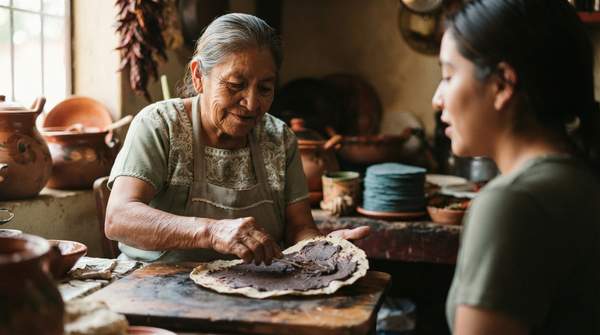
Every charming American town has two food scenes: the one that belongs to the people who live there, and the one that belongs to the visitors. The difference is rarely announced on a sign, but it can be tested. I've come to judge any meal, market stall, or food tour by three principles—connection to place, cultural narrative, and creator interaction—and together they form a repeatable framework for deciding whether an experience is genuinely local or merely dressed up that way.
Beyond Taste: Defining Culinary Authenticity
Authenticity is a slippery word, and travel writing tends to use it as a compliment rather than a description. But the concept has real structure. Chef Karl Wilder, writing for The Chef's Tours, argues that authentic food experiences "transcend mere culinary consumption" and sit at the intersection of cultural narrative, tradition, and sensory exploration—food as "a dynamic storytelling medium that connects people to their cultural roots."
Academic research on food tourism points the same direction. A study on tourists' value perceptions of food experiences defines cultural value as the utility of a food experience that satisfies the desire to learn about a destination's traditions and customs, while sampling regional cuisine fulfills curiosity and the need for knowledge. In other words, an authentic meal teaches you something about where you are. That gives us three testable principles.
Principle 1: Connection to Place
The first question is the simplest: does this food belong here? Authentic experiences draw on regional or indigenous ingredients and reflect the local environment—the things that actually grow, graze, or get pulled from the water nearby. A restaurant that sources from area farms and a market stall selling what the vendor grew that week both pass this test; a kitchen importing everything familiar to out-of-towners does not.
Place also means ownership. Choosing locally owned restaurants, as West Palm Beach Food Tours puts it, keeps your travel dollars in the community and gives you "a meal that actually feels like the place you're visiting." Local ownership is an observable indicator: it usually signals stronger ties to the surrounding food economy and a stake in representing it honestly.
Principle 2: Cultural Narrative
The second principle asks what the food can tell you. Understanding the historical and cultural context of a dish, as Wilder frames it, "deepens appreciation and transforms meals into meaningful exchanges." Look for traditional preparation methods, dishes the region is known for, and menus that explain themselves—a chowder with a story, a barbecue style with a lineage.
Here Wilder adds a warning worth carrying with you: "Be cautious of commercialised offerings that often simplify and misrepresent authentic culinary experiences." Simplification is the tell. When a dish has been sanded down for a generic palate, stripped of its history, or renamed into something more marketable, the narrative has been traded away. The absence of any story at all is itself a signal.
Principle 3: Creator Interaction
The third principle is about people. The most reliable authenticity test I know is a conversation: ask the owner what dish they're known for and what you should order. As the West Palm Beach Food Tours guidance observes, "Suddenly dinner becomes more than dinner." Interaction with the people who make the food provides context that no menu can.
The same source recommends asking shop owners, bartenders, market vendors, and guides where they take friends who come to town, or where they go when craving their favorite local dish—"Those questions tend to uncover the good stuff." Avoya Travel's guidance echoes this: food tours and cooking classes led by locals offer insider access to regional specialties, with "context and storytelling that elevate meals into cultural lessons." When a creator can't or won't engage, you're buying a product; when they can, you're having an encounter.
The Authenticity Evaluation Framework
Here is the full decision matrix. To use it, take any candidate experience—a restaurant, a market stall, a tour—and work down the three principles, asking the questions and looking for the signs in the middle column. The judgment falls out of the answers: strong performance on all three principles marks an experience as more authentic; weakness across them marks it as less authentic and probably commercialized.
| Principle | Definition and indicators | How to apply it |
|---|---|---|
| Connection to Place | Regional or indigenous ingredients; a sense of belonging to the local environment; locally owned establishments. | Ask where ingredients come from; favor locally owned restaurants so your money stays in the community. |
| Cultural Narrative | Historical background, traditional preparation methods, and the personal stories attached to the food. | Look for dishes the region is known for; watch for simplified, commercialized offerings that strip out tradition. |
| Creator Interaction | Direct engagement with local chefs, vendors, or producers who share their stories and expertise. | Talk to owners and vendors; ask what they're known for and where they take visiting friends. |
| Restaurants | Local ownership supports the community and often indicates a stronger connection to place. | Skip chains; ask the owner what to order and why. |
| Local Markets | Vendors can explain sourcing and preparation methods for what they sell. | Ask vendors about their produce and products; treat their answers as your evidence. |
| Food Tours and Classes | Locally led tours offer curated insider access and storytelling that turn meals into cultural lessons. | Book a local-led tour early in your trip; use it to scout places worth returning to. |
Applying the Framework: Restaurants
Start by skipping anything you could eat back home—chains fail the place test by definition. Then let the principles do the sorting. A locally owned kitchen that can tell you what dish it's known for, and whose owner will talk to you about it, scores on all three. Before your trip, follow local food publications and chefs on social media rather than generic "10 best" lists, as the West Palm Beach Food Tours guidance suggests, so you arrive with locally sourced candidates rather than algorithmically sourced ones.
Applying the Framework: Local Markets
Markets are the easiest place to run the test, because the creators are standing right in front of you. Walk the stalls, ask vendors what they grew or made and how, and watch for the ones who light up answering. A vendor who can tell you the farm, the season, and the preparation method passes the place and narrative principles on the spot; one who can't, or who is reselling anonymous goods, doesn't. The conversation is the evaluation.
Applying the Framework: Food Tours and Classes
A good tour is a compressed version of the whole framework: several locally owned restaurants in a few hours, with the city's history, culture, and food traditions explained along the way. The same guidance recommends taking the tour at the beginning of your vacation, not the end—use it as reconnaissance, letting the guide's stories and the stops you loved point you toward the places worth returning to on your own. Cooking classes led by locals work the same way, adding hands-on creator interaction to the narrative.
Making Your Authentic Culinary Choice
Travelers can confidently choose culinary experiences that offer genuine cultural immersion by applying the three-principle authenticity framework—Connection to Place, Cultural Narrative, and Creator Interaction—to restaurants, markets, and food tours. The measurable indicator of success is this: the traveler consistently identifies and selects food experiences that feature local ingredients, traditional preparation, and direct engagement with local creators, leading to a deeper sense of cultural connection. When your choices keep passing that test, you're no longer eating like a tourist—you're eating like someone who briefly belonged to the town.
Sources
- What Defines an Authentic Food Experience Today — The Chef’s Tours
- How Do Tourists’ Value Perceptions of Food Experiences Influence Their Perceived Destination… — PMC
- What Is Culinary Tourism? 10 Ways to Eat Like a Local — West Palm Beach Food Tours
- Why Local Cuisine Is Key to Authentic Travel — Avoya Travel