At first glance, a hand-built jar from a New Mexico pueblo and a glazed jug from the North Carolina foothills might simply read as "old American pottery." But these two traditions announce themselves differently at every stage of making, and those differences are exactly what a collector or decorator can learn to see. Pueblo pottery is coil-built without a wheel, finished with polished mineral slips and fired with organic fuels; Catawba Valley stoneware is defined by a local clay and a wood-ash alkaline glaze that turns glassy brown or green in the kiln. Once you know what to look for, telling them apart becomes straightforward.
Understanding American Regional Pottery: Pueblo vs. Catawba Valley
These two traditions grew from entirely different roots, which explains much of their visual character. Pueblo pottery belongs to an Indigenous Southwestern tradition that, according to the Indian Pueblo Store's collector guide, is a "thousand-year-old" art form carried by the Pueblo peoples of New Mexico. Catawba Valley pottery, by contrast, arrived with European settlers: as WNC Magazine recounts, Germans traveling the Great Wagon Road from Pennsylvania brought Rhineland pottery traditions to the valley, producing whiskey and molasses jugs, milk crocks, and kraut jars for pickling. One is ceremonial and artistic heritage; the other began as utilitarian farmware.
Southwestern Pueblo Pottery: Hand-Coiled Artistry
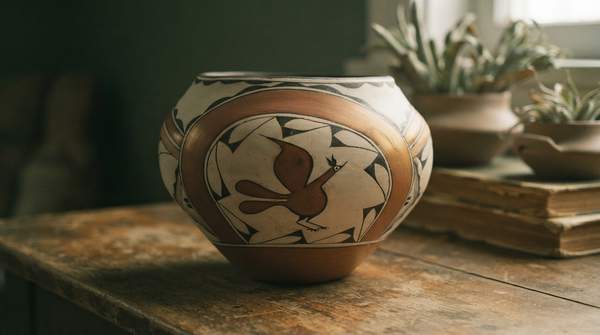
The defining fact of Pueblo pottery is construction. Every piece, in the language of the Indian Pueblo Store's guide, is "hand-coiled and shaped without a potter's wheel," built up through the traditional horizontal coil method. An overview of Indigenous American ceramics from Folkroom describes the same technique more generally: clay is rolled into long, thin strands stacked upon one another while the potter blends them together until the original ropes of clay disappear. That fusion of coils into a seamless wall is the skill at the tradition's heart.
Finish and firing follow suit. The collector's guide describes pots polished with a natural stone such as a river stone, then painted with vegetal, mineral, or commercial slips before being fired outdoors or in a kiln with organic fuels like wood or manure. The Folkroom overview adds that tempering materials are worked into the clay to strengthen it, and notes that potter's wheels were not used prior to European contact and remain rare among Native American artists today. The polished, unglazed surface and its soft stone-burnished sheen are the visible result.
North Carolina Catawba Valley Stoneware: Glazed Utility
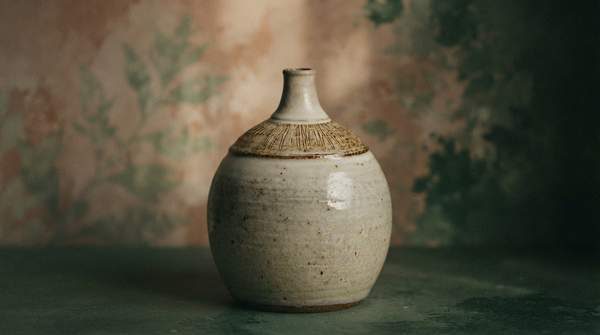
Catawba Valley pottery is a different animal in both material and finish. Its historical encyclopedia entry states that from the earliest known product onward, the valley's stoneware has been alkaline glazed, made by combining hardwood ash or crushed glass with clay and water. WNC Magazine records one potter's specific recipe for that glaze: seven parts wood ash, five parts ground glass, and two parts clay.
The result is a surface that browns or greens in the kiln fire, with variations in color and texture depending on the recipe and the firing. Local clay is the other signature. WNC Magazine's reporting credits the valley's native clay as what "seals the deal" for the tradition, quoting potter Kim Ellington's observation that it is incredibly light despite supporting large forms. Notably, the valley's potters chose alkaline glazes over salt glaze, the predominant American stoneware glaze of the era, giving their work a regional identity all its own.
Comparative Guide: Pueblo vs. Catawba Valley Pottery
| Attribute | Southwestern Pueblo Pottery | Catawba Valley Stoneware |
|---|---|---|
| Cultural origin | Indigenous Pueblo peoples of New Mexico; a thousand-year-old tradition | German settlers via the Great Wagon Road from Pennsylvania; Rhineland farmware traditions |
| Typical forms | Jars and vessels built for art and ceremony | Whiskey and molasses jugs, milk crocks, kraut jars for pickling |
| Construction method | Hand-coiling (horizontal coil method); no potter's wheel | Wheel-based stoneware production implied by the European tradition; coil-building is absent from the record |
| Clay and temper | Local clay tempered with added materials to prevent cracking | Local valley clay noted for strength and lightness in large forms |
| Surface finish | Stone-polished, painted with vegetal, mineral, or commercial slips; unglazed | Alkaline glaze of hardwood ash or crushed glass, clay, and water |
| Firing | Outdoors or in a kiln with organic fuels like wood or manure | Kiln firing; glaze turns brown or green in the fire |
From Clay to Finish: How Techniques Shape Appearance
Each tradition's surface tells the story of how it was made. Pueblo pottery's sheen does not come from glaze at all: it comes from burnishing a slip with a stone before firing, which is why a Pueblo pot feels smooth and matte-to-satin rather than glassy. Its painted decoration sits on that polished ground, applied before an outdoor or kiln firing fed by wood or manure.
Catawba Valley work inverts that logic entirely. Here the decoration is the glaze, an ash-and-glass melt that flows over the pot and fuses into a glassy, brown-or-green coating in the kiln. Where Pueblo finishing celebrates the raw, polished clay body, the Catawba Valley potter's craft centers on the chemistry of ash, glass, and clay over the valley's famously light local stoneware clay. Two vocabularies of fire, two vocabularies of surface.
Distinguishing Your Pottery: A Collector's Decision
When evaluating a piece of American folk pottery, carefully observe its construction method (hand-coiled versus a form suggesting wheel-based stoneware production), its surface finish (an unglazed, polished, painted slip versus an alkaline glaze), and its material character to determine whether it aligns with the Southwestern Pueblo or North Carolina Catawba Valley tradition.
The measurable indicator is simple to check: the presence of distinct hand-coiling construction and a polished, painted, unglazed surface points to Pueblo pottery, while a glassy, brown-or-green alkaline glaze over a light local stoneware clay points to Catawba Valley work. Neither test requires touching a price tag—though this guide deliberately stops short of valuation advice. Handle a few pieces of each, run your eyes and fingers over those two indicators, and the traditions will separate themselves.
Sources
- Out of the Ashes — WNC Magazine
- Pottery Collector's Guide — Indian Pueblo Store
- Ceramics of indigenous peoples of the Americas — folkroom
- Catawba Valley Pottery - Wikipedia — EN